
Task Definition
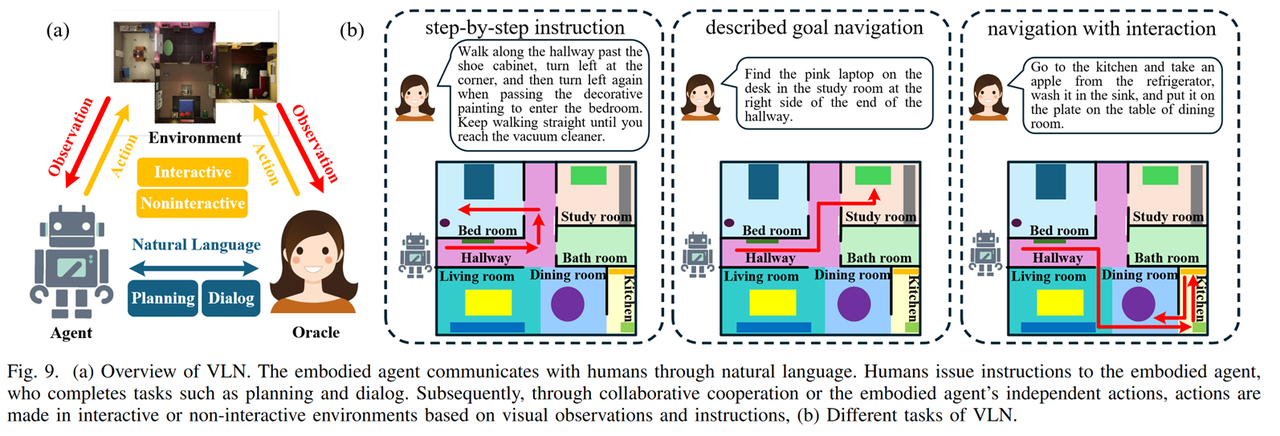
Visual Language Navigation (VLN) is a key research issue in embodied AI, aiming to enable agents to navigate in an invisible environment according to linguistic instructions. VLN requires robots to understand complex and diverse visual observations while interpreting instructions at different granularities.
VLN input typically consists of two parts: visual information and natural language instructions. Visual information can be videos of past trajectories or a collection of historical-current observation images. Natural language instructions include the goals that the embodied AI needs to achieve, or the tasks that the embodied AI expects to perform. The embodied agent must use the above information to select one or a series of actions from a candidate action list to fulfill the requirements of the natural language instructions.
Task Setup
The Visual Language Navigation (VLN) task can be uniformly modeled in mathematical form as a partially observable Markov decision process (POMDP), described by tuples:
Among them,
Under this framework, the core of navigation problems lies in learning a policy mapping function
Based on differences in the state space, action space, and state transition function, VLN tasks are divided into discrete VLN and continuous VLN.
Discrete Environment Visual Language Navigation (VLN) Task Setup
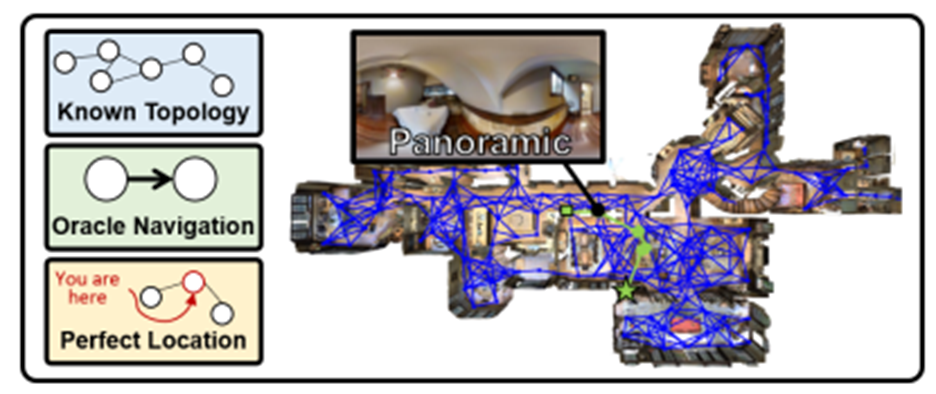
Figure 1: Discrete environment VLN. Blue connecting lines represent the predefined connected graph; green lines represent expert trajectories.
Discrete VLN research is primarily carried out using the Matterport3D simulator. As shown in Figure 1, the environment is abstracted as a predefined connected graph
- State space (
): The state of the agent is strictly limited to a node in the graph , namely . - Action space (
): It is assumed that at time , all connected nodes in the graph surrounding the agent’s state are represented as . Each node in is called a candidate node, and is the action space of the agent at time . The action decision at time by the agent is represented as “selecting a candidate node”. The policy function outputs a probability distribution for , which is used to choose a node from the candidate nodes as the next “jump point”. - State transition (
): State transition occurs through a deterministic “invisible teleportation” mechanism. Once the next “jump point” is generated, the system instantly switches the agent’s position to the coordinates of the selected candidate node. This process ignores intermediate paths and does not consider physical collisions or friction. Although this “Oracle Navigation” setting simplifies control complexity, it significantly deviates from the motion laws of real robots in real environments.
Navigation Language in Continuous Environment (VLNCE) Task Setup
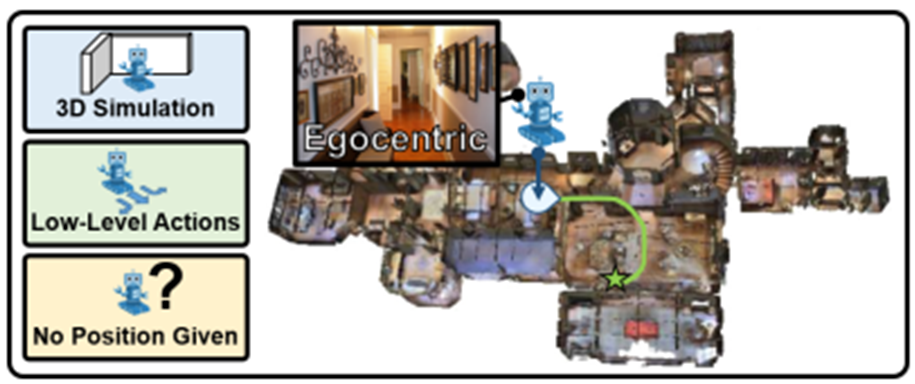
Figure 2 Continuous Environment VLN. Green lines represent expert trajectories.
To bridge the gap between the simulation environment and the real world, VLN-CE is trained in the Habitat simulator. As shown in Figure 2, this environment loads a highly realistic indoor 3D scanning scene from the Matterport3D dataset, providing a first-person visual experience consistent with the real world. Meanwhile, Habitat introduces a navigation grid to define the physical motion space. This grid transforms the walkable areas of the environment into a series of tightly connected polygonal surfaces, allowing the agent to remain at any continuous coordinate point within the grid range. It is this spatial continuity that enables the agent to perform basic actions such as “moving a fixed distance” and “rotating by a fixed angle” with the support of the physics engine. When the agent executes a step forward command (e.g., 0.25 meters), the navigation grid ensures that this is not just a jump in coordinate values, but a real sliding displacement process on the continuous geometric surface, thereby handling continuous pose changes similar to those in the real world. Compared to the “jumping” movement of the agent in discrete VLN from one node to an adjacent node, the smooth motion of the agent in continuous VLN based on the navigation grid more closely mirrors the movement patterns in a real environment.
- State space (
): The state of the agent is represented by precise three-dimensional coordinates and orientation angles in the world coordinate system, where the former represents the pitch angle and the latter represents the yaw angle. - Action space (
): The action space of the agent at any given moment consists of a set of low-level action primitives, as shown by the “Low-Level Actions” label in Figure 2. These include moving forward at a fixed distance (e.g., 0.25 meters), rotating by a fixed angle to the left (e.g., 15°), rotating by a fixed angle to the right (e.g., 15°), and stopping. The action decision at time is characterized by “selecting an action primitive”, and the policy function outputs a probability distribution over all action primitives, from which one specific motion control command is chosen. - State transition (
): State transitions are strictly constrained by the dynamics rules of the simulator’s physics engine. When the agent performs an action that causes contact with a physical object in the environment, a “sliding” or collision mechanism is triggered.
VLNCE Task Dataset
Common dataset
1. R2R-CE
Simulator
- Simulation Environment: Habitat-Sim v0.1.7
- Environment Scenarios: 90 real indoor scenarios based on the Matterport3D (MP3D) dataset (houses, offices, etc.).
**Input **
Observation space at every moment (
- Visual input: RGB-D images (RGB + depth maps).
- Resolution: Typically, the resolution of RGB images is (224×224), and that of Depth images is (256×256).
- Field of view (FOV): 90 degrees.
- Viewing angle: Here, it defaults to a monocular view. Many models such as ETPNav construct a panoramic view by rotating from left to right 12 times (at intervals of 30°).
Text Instruction
- Language: English only.
- Type: Step-by-Step. The instruction not only tells the agent “where to go (destination)”, but also provides a description of an action sequence. It explains how the agent should navigate step by step from the current location to the endpoint.
- Example: “Go down the stairs, turn left at the picture and enter the bedroom.”
Output (Action Space)
- The agent outputs discrete low-level control commands:
MoveForward(move forward 0.25 meters)TurnLeft(rotate left by 15 degrees)TurnRight(rotate right by 15 degrees)Stop(stop and check if the goal is reached)
- Decision criterion: When the agent performs
Stop, if the distance to the target point is within 3.0 meters, it is considered a success.
Dataset Size
- Number of paths: Approximately 4,475 continuous trajectories (reconstructed from discrete R2R paths).
- Number of instructions: Approximately 13,425 (with an average of 3 instructions per path).
- Average path length: Approximately 9.89 meters.
- Division: Training set (10.8k), Validation set (Seen: 778 / Unseen: 1.8k), Test set (3.4k).
2. RxR-CE
Simulator
- Simulation Environment: Habitat-Sim v0.1.7
- Environment Scene: Also based on the Matterport3D (MP3D) dataset. However, compared to R2R-CE, RxR-CE sampling has a higher path coverage rate, exploring more complex areas and loops.
** Input **
Observation space at every moment (
- Visual input: RGB-D images (RGB + depth maps).
- Resolution: Typically, the resolution of RGB images is (224×224), and that of Depth images is (256×256).
- Field of view (FOV): 79 degrees.
- Note: The default is a monocular perspective.
Text Instruction
- Instruction language: Multilingual. Includes English (English), Hindi (Hindi), Telugu (Telugu).
- Instruction type: Process-Oriented. The instructions are very detailed, describing not only the sequence of actions but also all visual details along the way, like a “guide”. Most importantly, the words in the instructions align with the agent’s pose on the path over time.
- Example: “Stand on the rug, turn right and face the wooden cabinet. Walk past the cabinet, keeping it on your left, and enter the hallway. You will see a painting of a flower on the wall. Stop just after passing the painting.”
Output
- Action space: Consistent with R2R-CE.
- Decision criteria:
- Success criterion: Within 3.0 meters of the target point.
- Path consistency (NDTW): The task emphasizes whether the agent truly follows the route described in the instructions.
Dataset Scale
- Number of paths: Approximately 42,000+ continuous trajectories (one order of magnitude larger than R2R).
- Number of instructions: Approximately 126,069.
- Average path length: Approximately 15 meters.
Dataset acquisition address: https://github.com/jacobkrantz/VLN-CE
Evaluation Criteria
(1) Navigation Error (NE) Defined as the average geodesic distance (in meters) between the final stopping position of the agent and the target position.
(2) Success Rate (SR) Defined as the proportion in which the geodesic distance between the agent’s stopping position and the target position is less than a specific threshold (standardly set at 3m).
(3) Success weighted by Path Length, SPL SPL is a core metric of VLN-CE. It aims to balance “success rate” and “path length”.
(4) Oracle Success Rate (OSR) If the geodesic distance between any point in the agent’s trajectory and the target is less than the threshold, it is considered a success. OSR measures the agent’s potential to “pass” through the target. The gap between OSR and SR usually reflects defects in the agent’s stop policy.
(5) Normalized Dynamic Time Warping (nDTW)
nDTW uses a dynamic programming algorithm to calculate the minimum cumulative distance between the predicted trajectory
(6) SDTW (Success weighted by normalized Dynamic Time Warping) SDTW calculates the nDTW metric of tasks that successfully reach the endpoint, serving as a comprehensive indicator of “command compliance” and “task completion rate”.
Continuous Environmental Visual Language Navigation Method
1. Traditional single-stage method
Basic End-to-End Baseline Model (2020 ECCV)
Paper Title: Beyond the Nav-Graph: Vision-and-Language Navigation in Continuous Environments Authors: Jacob Krantz, Erik Wijmans, Arjun Majumdar, Dhruv Batra, Stefan Lee Institution: Oregon State University, Georgia Tech, FAIR Paper Link: PDF Link | Project Link: Project Page
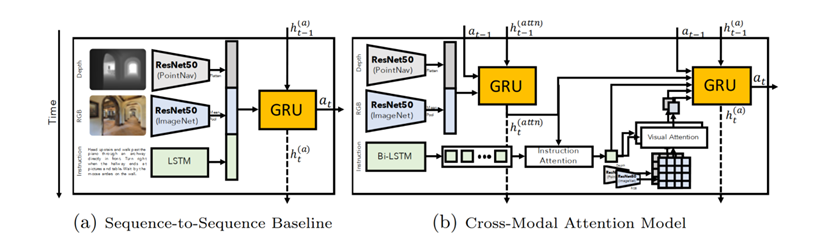
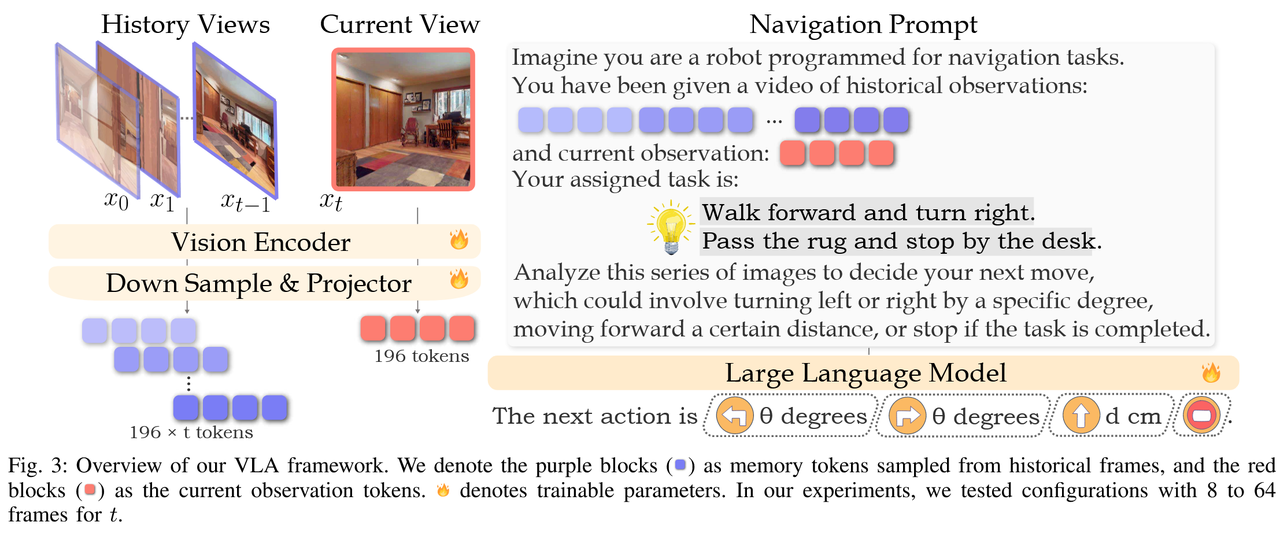
Method Overview: It mainly includes the Sequence-to-Sequence (Seq2Seq) model and the Cross-Modal Attention (CMA) model. It adopts an end-to-end architecture, and the model directly outputs the probability of low-level actions.
- Seq2Seq Architecture (Figure a): The language encoder (LSTM) compresses the instruction into semantic vectors; the action decoder (RNN) predicts the action distribution based on the semantic vectors and current visual features.
- CMA Model (Figure b): An attention mechanism is introduced. The current visual features are used as Queries, and cross-attention calculations are performed with the instruction feature sequence. This dynamically focuses on relevant instruction segments, achieving fine-grained alignment between vision and language.
2. Traditional Two-Stage Navigation Method
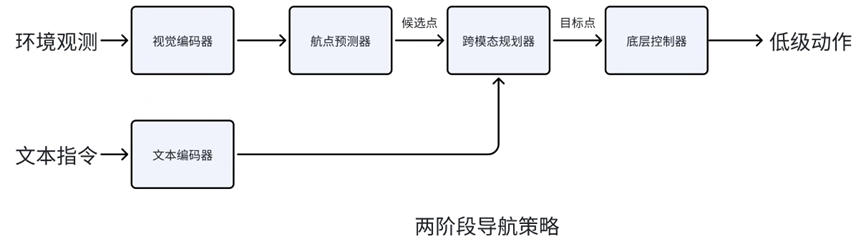
Using a hierarchical structure, the navigation is divided into two stages: “decision-making” and “execution”.
- Decision-making stage: Based on the panoramic map and instructions, the next high-level goal point (Local Goal / Waypoint) is predicted, usually at the
coordinate. - Execution stage: The underlying controller receives the target point coordinates, and an algorithm (such as DWB) automatically plans the path and controls the agent to reach that point.
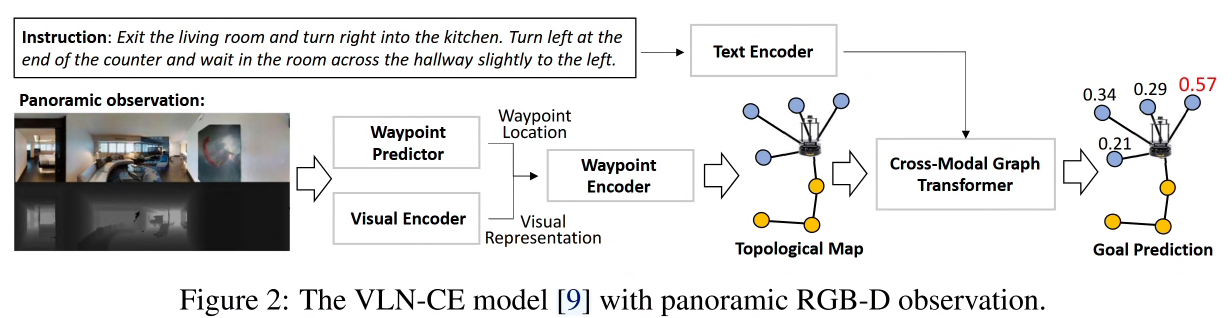
(1) Introduction of the waypoint predictor: The beginning of two-stage navigation
Paper Title: Bridging the Gap Between Learning in Discrete and Continuous Environments for VLN (2022 CVPR) Authors: Yicong Hong, Zun Wang, Qi Wu, Stephen Gould Institution: ANU, University of Adelaide Paper URL: PDF Link | Project URL: GitHub
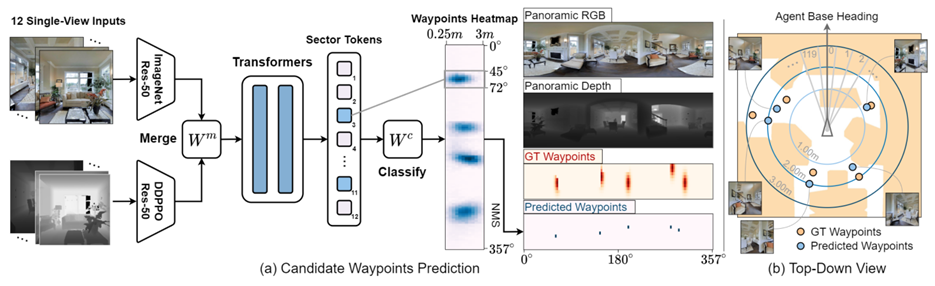
Methodological Innovations:
- Candidate Waypoint Predictor: Generates real-time “virtual nodes” that are accessible in continuous environments based on depth maps, making the continuous space appear like a discrete navigation map.
- Hierarchical Navigation System: Divided into “high-level planning” and “low-level execution”.
- Discrete-to-Continuous Migration: Demonstrates that fine-tuning a model trained in a discrete environment (Nav-Graph) can achieve SOTA performance in a continuous environment.
(2) Map-based approach
Topological Map: ETPNav
Paper Title: ETPNav: Evolving Topological Planning for Vision-Language Navigation in Continuous Environments (2024 TPAMI) Authors: Dong An, Hanqing Wang, Wenguan Wang, Zun Wang, Yan Huang, Keji He, Liang Wang Institution: CASIA, UCAS Paper URL: PDF Link | Project URL: GitHub
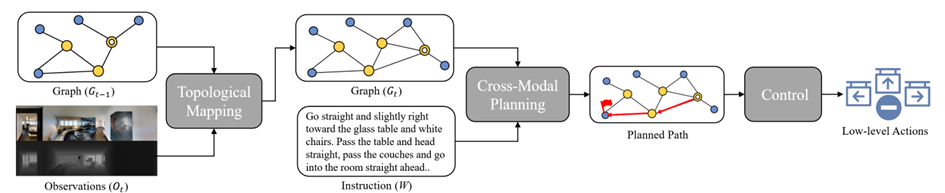
ETP navigation framework
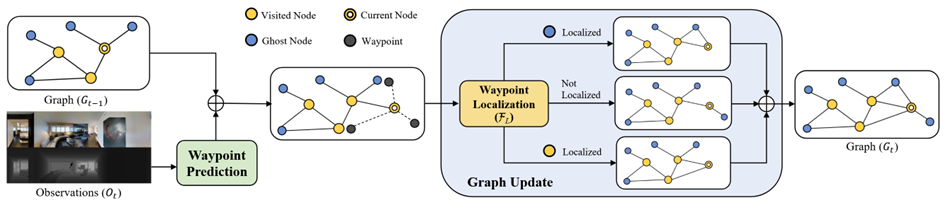
The process of ETPNav generating the topology diagram at time t
Method Overview: The core of ETPNav is Online Evolving Topological Mapping. It converts the unknown continuous physical space into a dynamically updated topological map in real time, storing historical information through the topological map.
- Cross-modal planner: Performs long-range semantic reasoning based on the topological map and instructions to select the optimal waypoint.
- Trial-and-Error Controller: Responsible for low-level action execution and robust obstacle avoidance, solving the problems where traditional models tend to get stuck or collide.
BEV Map: BEVBert
Paper Title: BEVBert: Multimodal Map Pre-training for Language-guided Navigation (2023 ICCV) Authors: Dong An, Yuankai Qi, Yangguang Li, Yan Huang, Liang Wang, Tieniu Tan, Jing Shao Institution(s): CASIA, UCAS, University of Adelaide, SenseTime, NJU, PJLab Paper Link: PDF Link | Project Link: GitHub
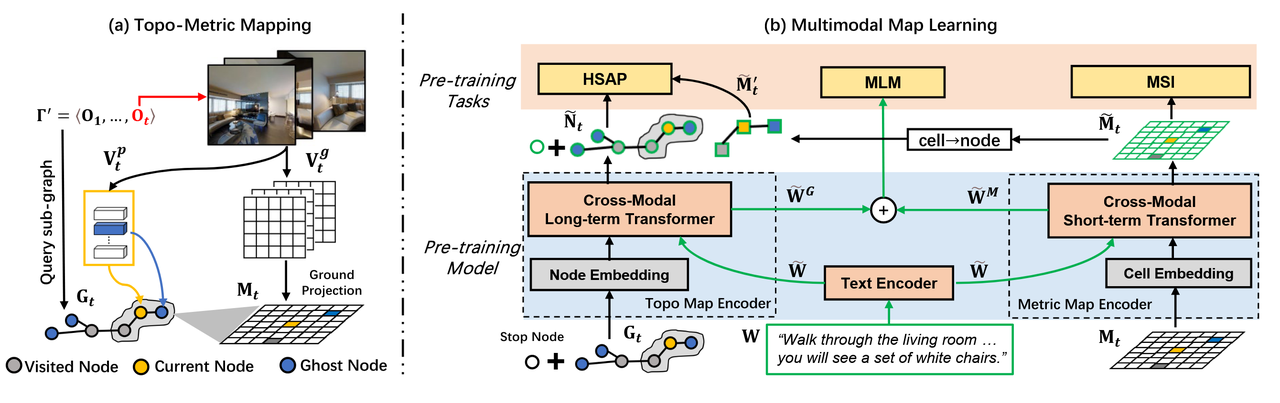
Method Overview: Proposes a multimodal map pre-training paradigm based on spatial perception.
- Hybrid Map: Combines a local bird’s-eye view (BEV) map used to eliminate visual overlaps, and a global topological map for remembering long-distance paths.
- Pre-training Tasks: Through tasks such as mask map modeling, the model can perform cross-modal inference directly on map representations.
(3) Method Based on Future Imagination
HNR
Paper Title: Lookahead Exploration with Neural Radiance Representation for Continuous Vision-Language Navigation (2024 CVPR) Authors: Zihan Wang, Xiangyang Li, Jiahao Yang, Yeqi Liu, Junjie Hu, Ming Jiang, Shuqiang Jiang Institution: ICT, CAS, UCAS Paper Link: PDF Link | Project Link: GitHub
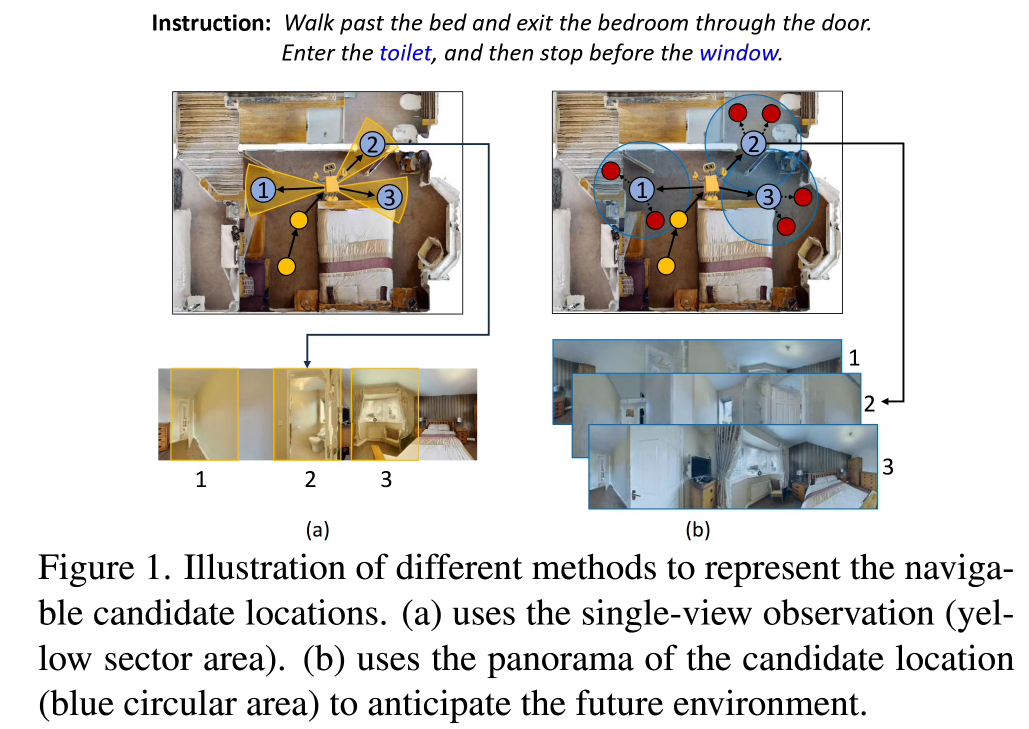
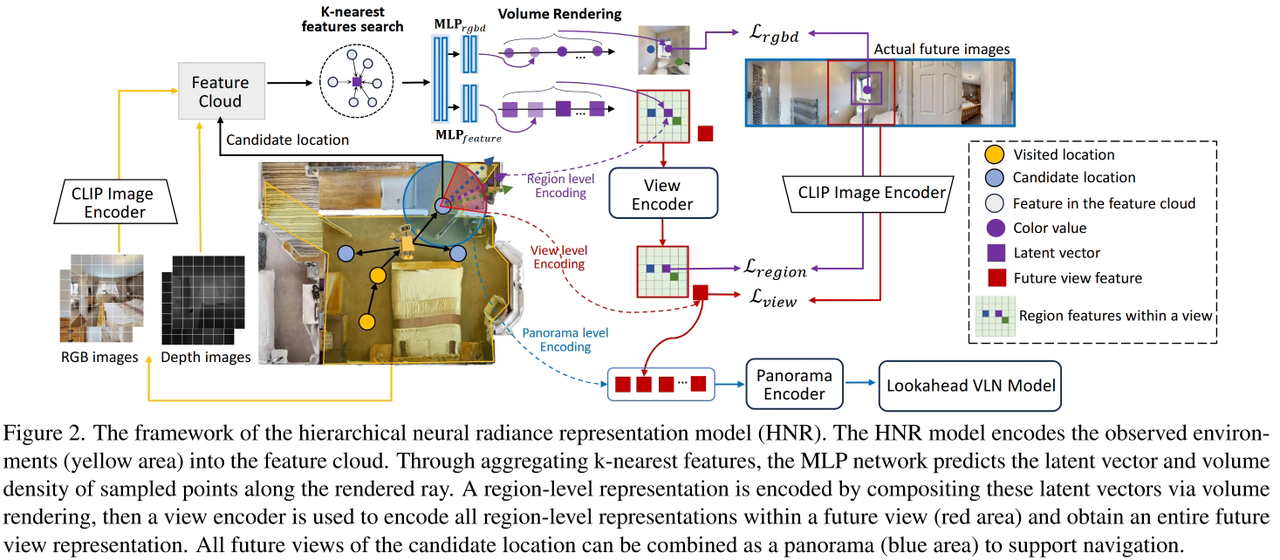
Method Overview: The Hierarchical Neural Radiation Representation (HNR) framework is proposed.
- Lookahead Exploration: By using CLIP semantic embedding to synthesize environmental features, and constructing a future path tree that extends beyond the current horizon, the agent can simultaneously evaluate the semantic match of multiple potential branches, thereby achieving a globally optimal path selection that balances long-term planning.
NavMorph (world model)
Paper Title: NavMorph: A Self-Evolving World Model for Vision-and-Language Navigation in Continuous Environments (2025 ICCV) Authors: Xuan Yao, Junyu Gao, Changsheng Xu Institution: CASIA, UCAS, Peng Cheng Lab Paper URL: PDF Link | Project URL: GitHub
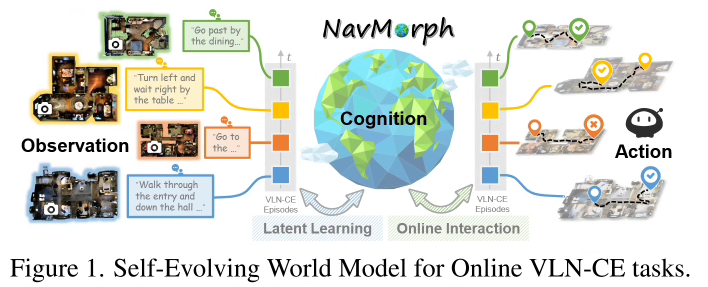
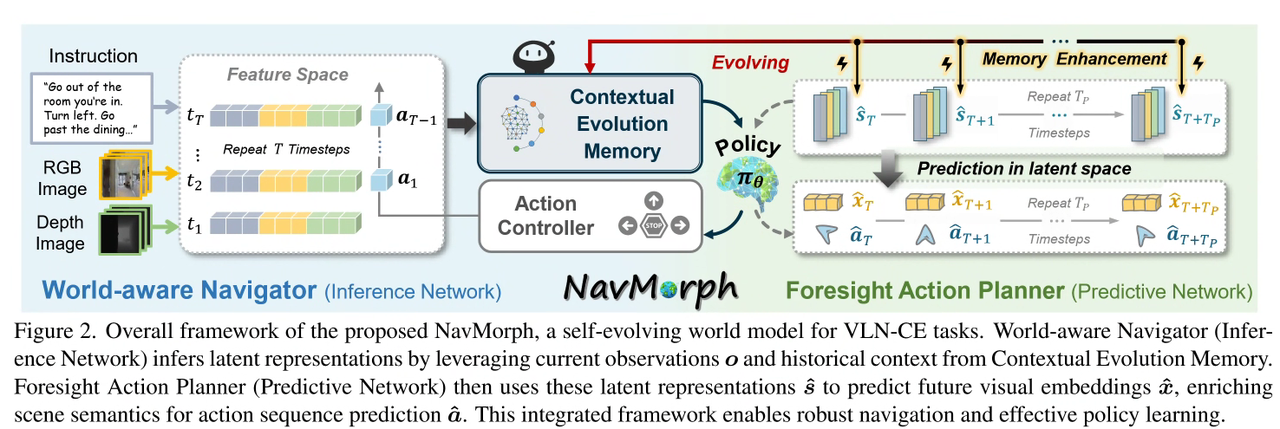
Methodological Innovations:
- Self-evolutioning world model: Builds an evolving latent space through online interaction.
- Contextual Evolution Memory (CEM): Uses a forward iteration update mechanism to quickly adapt to new scenarios during online testing.
- Hierarchical architecture: Comprises a “world-aware navigator” and a “forward action planner”. It abandons pixel-level prediction and replaces it with future prediction and reconstruction at the feature level, significantly improving efficiency.
(4) Methods based on Sim2Real (Virtual-to-Real Migration)
Sim2Real-VLN-3DFF
Paper Title: Sim-to-Real Transfer via 3D Feature Fields for Vision-and-Language Navigation (2024 CoRL) Author: Zihan Wang, et al. Paper Link: PDF Link | Project Link: GitHub
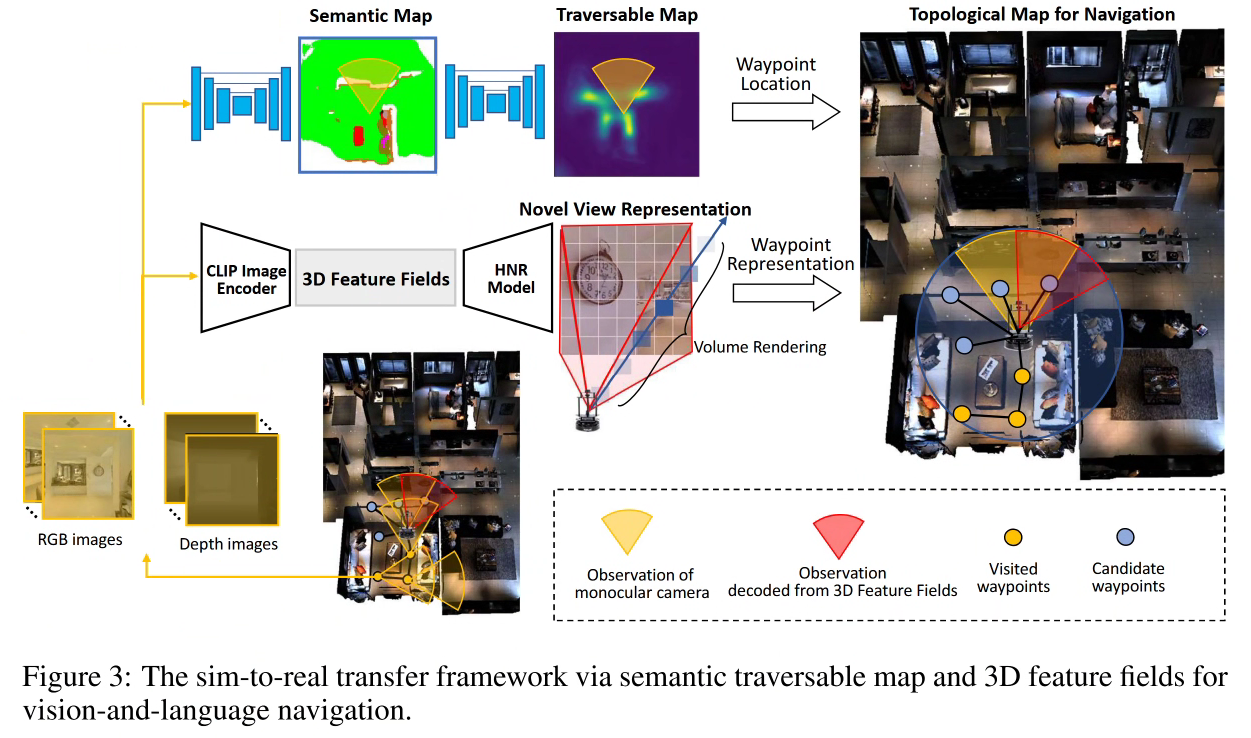
Core idea: To address the contradiction where real robots are typically equipped with monocular cameras but require panoramic input.
- 3D Feature Field: Using NeRF concepts, map monocular observations into 3D space to render virtual panoramas.
- Semantic traversable map: A central map for agents, which also performs environmental semantics alignment and obstacle prediction.
monoVLN
Paper Title: monoVLN: Bridging the Observation Gap between Monocular and Panoramic Vision and Language Navigation (2025 ICCV) Authors: Renjie Lu, Yu Zhou, Hao Cheng, Jingke Meng, Wei-Shi Zheng Institution: SYSU, HNU Paper Link: PDF Link
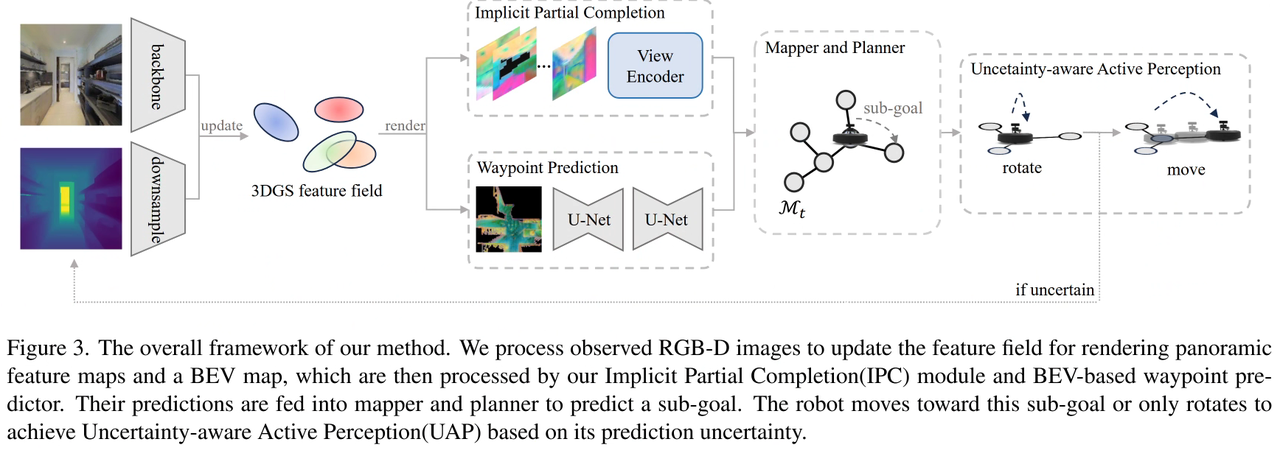
Methodological Innovations:
- 3D Gaussian Splatting (3DGS): Use 3DGS to rapidly reconstruct 3D feature fields and render virtual panoramas.
- Implicit Local Completion: Automatically predict and fill in the feature voids caused by occlusions.
- Uncertainty-Aware Policy: When the feature confidence is low, actively perform “turning” actions to collect data.
3. Zero-Shot Visual Language Navigation (Zero-Shot VLN)
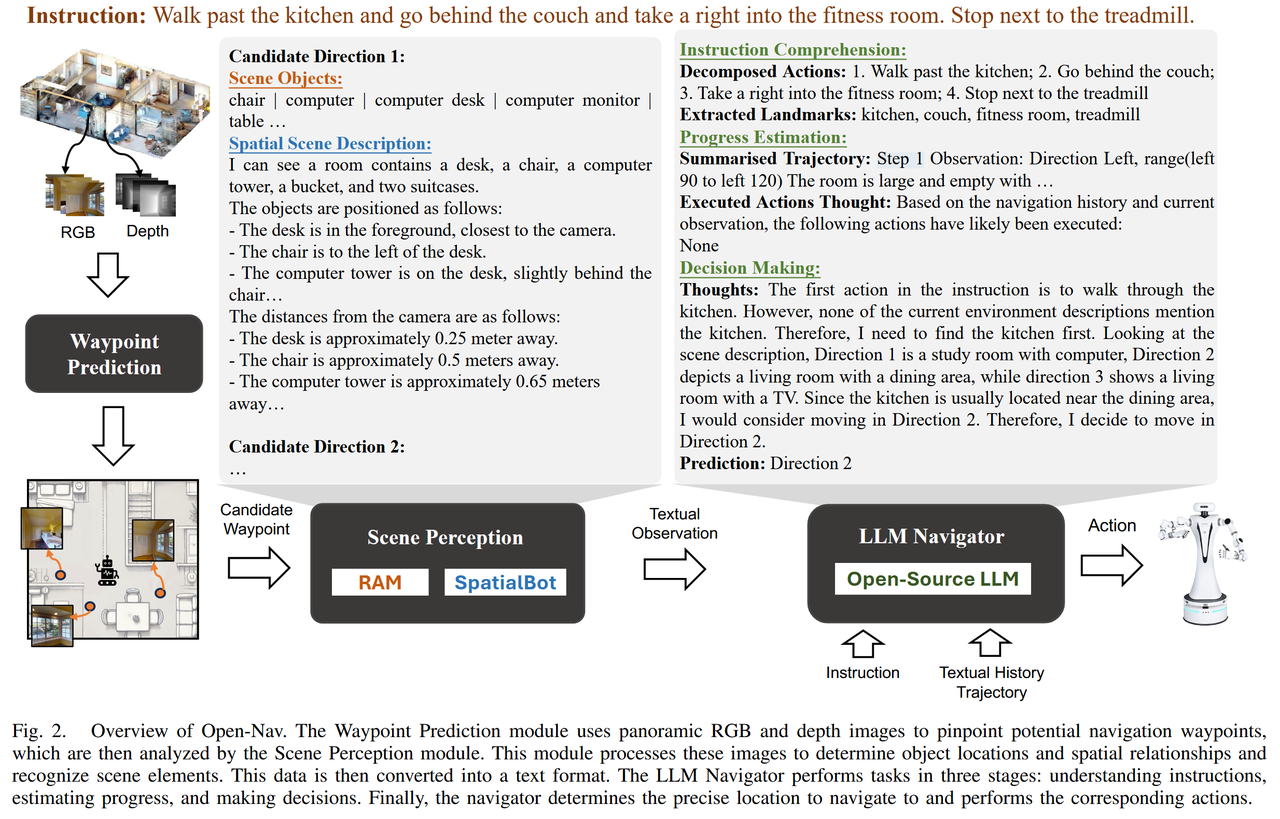
Open-Nav (2025 ICRA)
Paper: Open-Nav: Exploring Zero-Shot VLN with Open-Source LLMs GitHub: Link
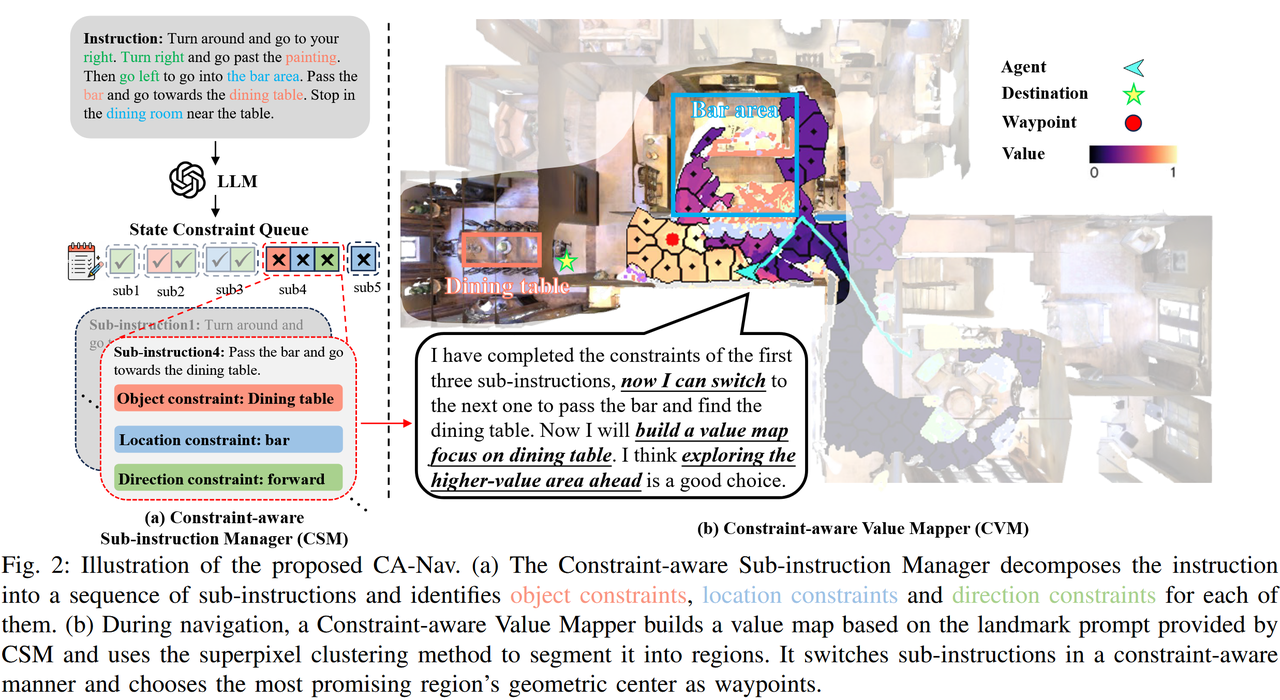
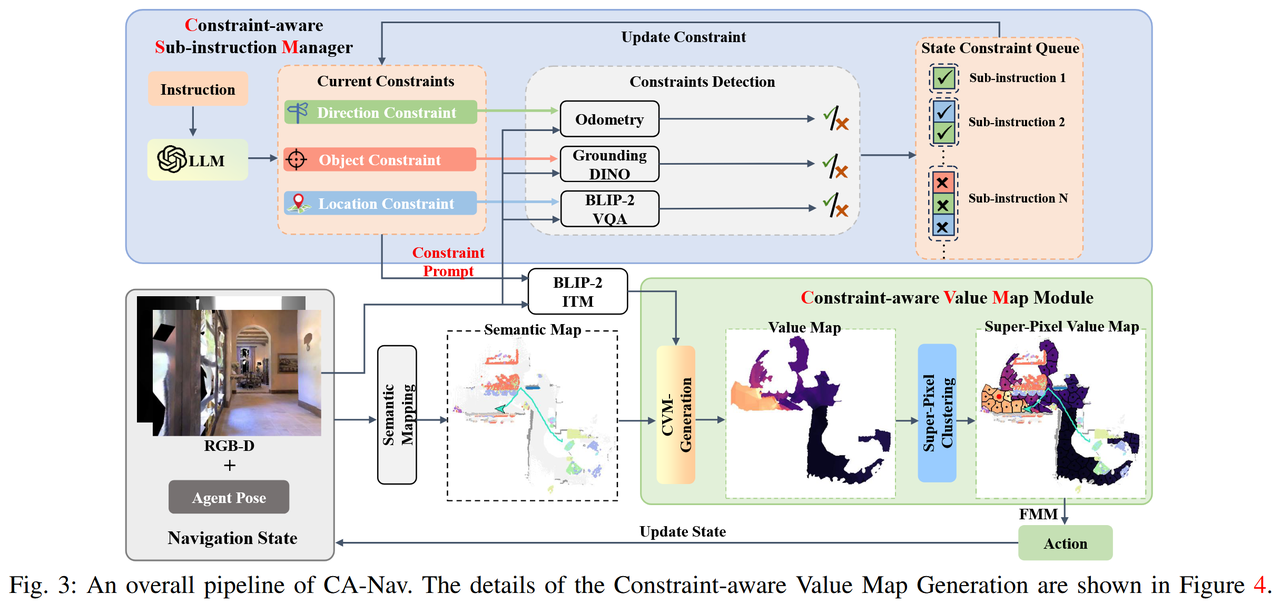
CA-Nav (2025 TPAMI)
Paper: Constraint-Aware Zero-Shot VLN GitHub: Link
Other Recent Work
- LaViRA: Language-Vision-Robot Actions Translation
- SmartWay (2025 IROS): Enhanced Waypoint Prediction
- Fast-SmartWay: Panoramic-Free End-to-End Zero-Shot
4. Methods Based on VLA (Vision-Language-Action)
The VLA model integrates perception, understanding, and control into a end-to-end framework, gradually replacing the modular architecture.
NaVILA
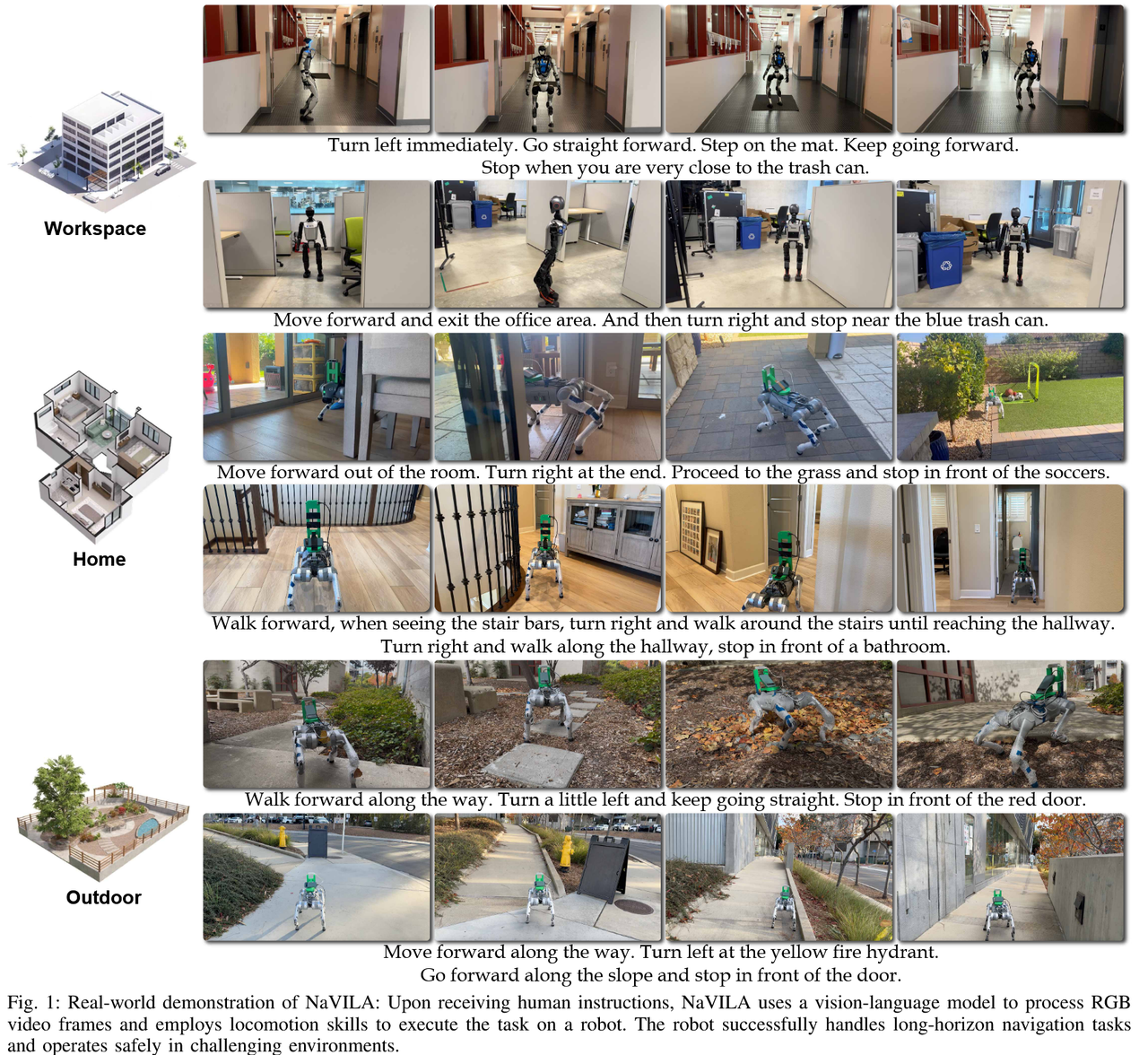
Paper Title: NaVILA: A Legged Robot Vision-Language-Action Model for Navigation Authors: An-Chieh Cheng, et al. Institution: UCSD, USC, NVIDIA Paper Link: PDF Link | GitHub: Link
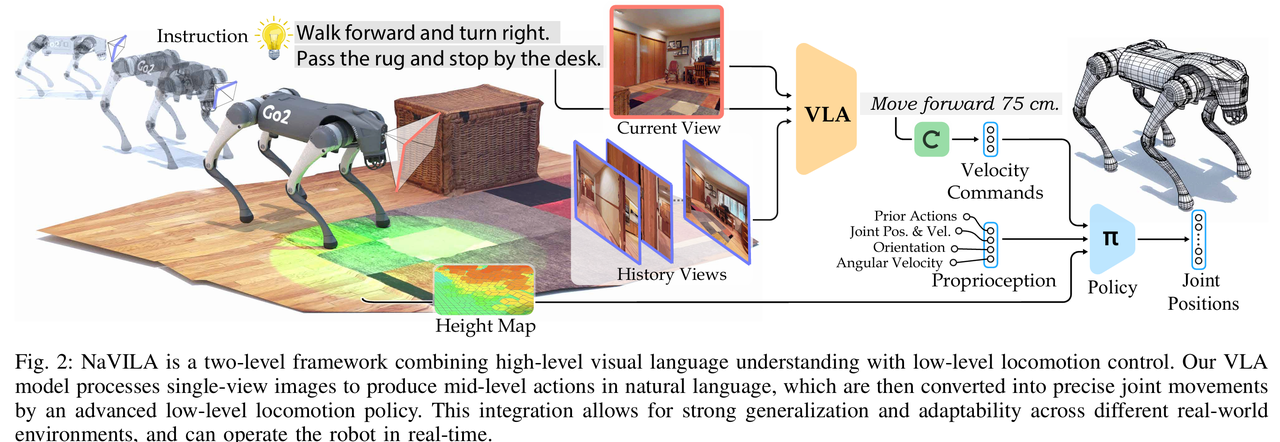
Method:
- Advanced VLA Layer: Outputs “intermediate actions” (such as “turn left by 30 degrees”), using internet video data augmentation.
- Low-Level Execution Layer: A policy based on RL, converting language commands into motor control commands.
StreamVLN
Paper Title: StreamVLN: Streaming Vision-and-Language Navigation via SlowFast Context Modeling Author: Meng Wei, et al. Institution: PJLab, HKU Paper Link: PDF Link | GitHub: Link
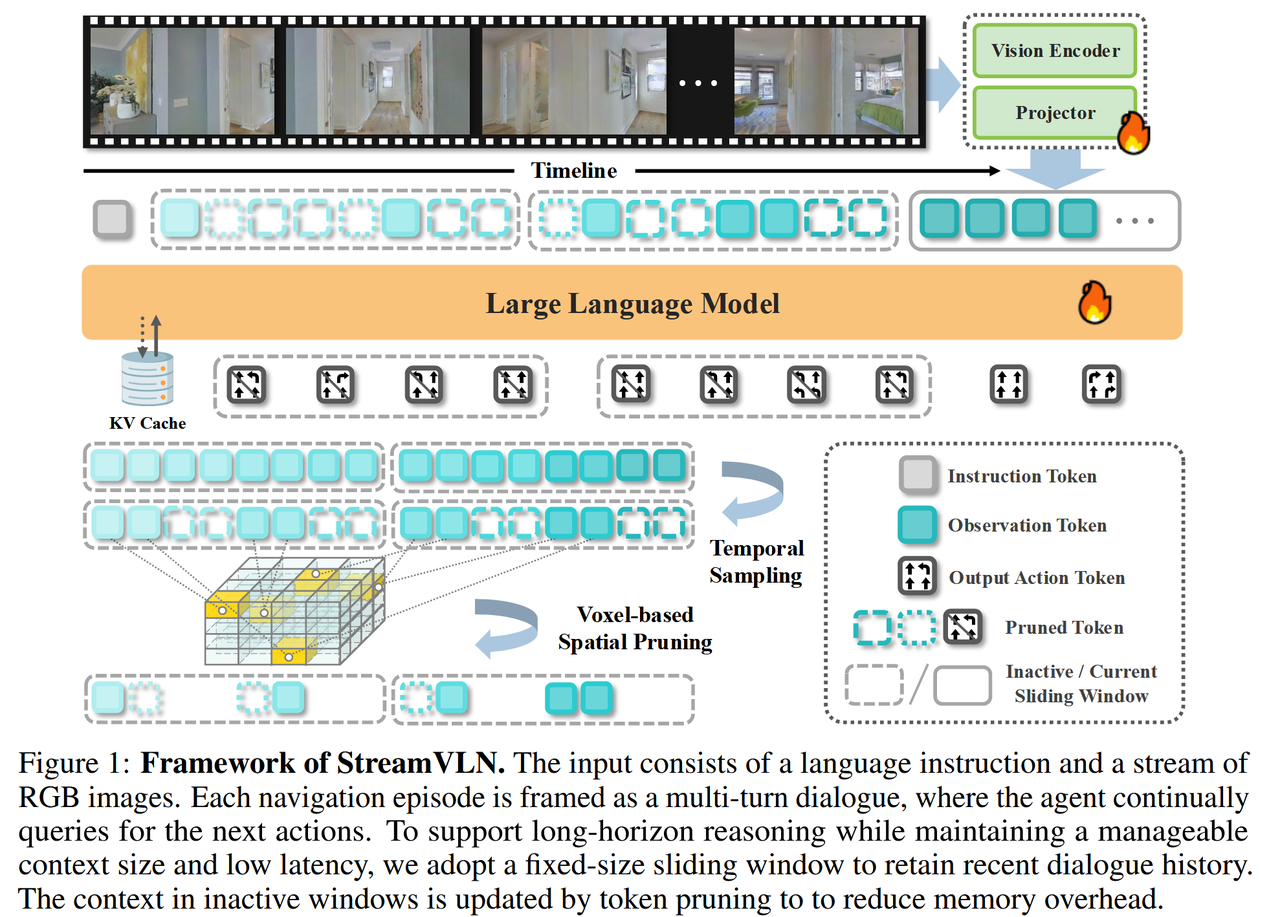
Core: SlowFast Context Modeling
- Fast-Streaming Context: Sliding window mechanism, focusing only on recent frames to ensure real-time response.
- Slow-Updating Memory: 3D Token pruning strategy, retaining only key landmarks to solve VRAM overflow issues and enable long-term streaming navigation.
DualVLN
Paper Title: GROUND SLOW, MOVE FAST: A DUAL-SYSTEM FOUNDATION MODEL Author: Meng Wei, et al. Institution: PJLab, HKU, Tsinghua Paper Link: PDF Link | GitHub: Link
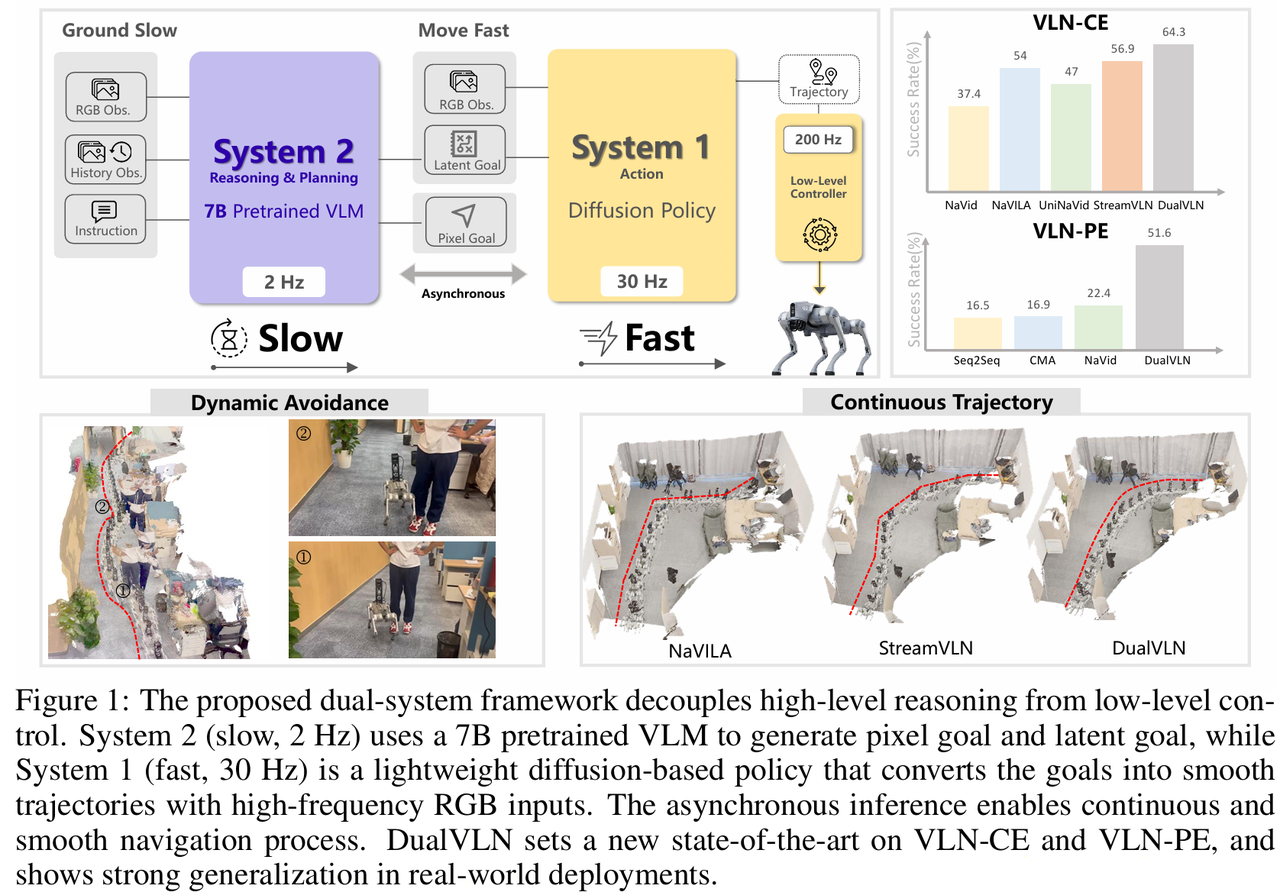
Method: Simulating Human “Dual Process Theory”
- System 2 (Slow and Grounded): Brain. The InternVLA large model is used for global planning, generating mid-term points (Pixel Goal) with low-frequency outputs.
- System 1 (Fast Movement): Cerebellum. A lightweight Diffusion Transformer outputs line speed and angular velocity, handling obstacle avoidance and motion control.