
Download:
https://huggingface.co/lerobot/smolvla_base
Models can be used with our tools
https://huggingface.co/datasets/nikriz/aopoli-lv-libero_combined_no_noops_lerobot_v21
It is recommended to use git lfs clone for data, as the individual files are small and the total amount is large.
bashgit clone https://github.com/huggingface/lerobot
cd lerobot && git stash
cd lerobot && git checkout d602e816 # 必须要这个版本,后续版本可能会报错!
git clone https://github.com/Lifelong-Robot-Learning/LIBERO
bashexport DATA_ROOT=/path/to/data
python3 download_hf_files.py nikriz/aopoli-lv-libero_combined_no_noops_lerobot_v21 main --repo-type dataset --download_path "$DATA_ROOT/aopoli-lv-libero"
Environmental configuration is required at the beginning
bash~$ micromamba create -n smolvla python=3.10 -c conda-forge --yes

~$ mamba activate smolvla_new
~$ pip install torch==2.7.1+cu121 torchvision==0.22.1+cu121 torchaudio==2.7.1+cu121 -f https://mirror.sjtu.edu.cn/pytorch-wheels/cu121/

pip install torch==2.7.1 torchvision==0.22.1 torchaudio==2.7.1 -f https://mirror.sjtu.edu.cn/pytorch-wheels/cu121/

# 特别注意!如果是windows,请执行这句:
pip install torch torchvision torchaudio --index-url https://download.pytorch.org/whl/cu124

cd lerobot && pip install -e ".[smolvla]"

cd LIBERO
pip install -e .
pip install robosuite==1.4.0
pip install bddl
pip install easydict
pip install gym
pip install matplotlib
To avoid warnings or deadlocks that may occur with the Hugging Face tokenizers library, it is recommended to set the following environment variables before running the script:
bashexport TOKENIZERS_PARALLELISM=false
You can add this command line to your ~/.bashrc or ~/.zshrc file, so you don’t need to reset it every time you log in.
Step 4: Fix the torch.load issue (if encountered)
When running the evaluation script, if the _pickle.UnpicklingError: Weights only load failed. error occurs, you need to manually modify the code of LIBERO.
-
Find the file:
.../LIBERO/libero/libero/benchmark/__init__.py(under the LIBERO repository path you cloned). -
Locate around line 164.
-
Paste:
Python
init_states = torch.load(init_states_path)Modified as follows:
Python
init_states = torch.load(init_states_path, weights_only=False)Just save the file.
Now, your environment is fully configured. You can reproduce the results of SmolVLA on LIBERO using the training and evaluation commands summarized in the Issue.
Step 1 is to train smolvla on the free subset
bashexport MODEL_ROOT=/path/to/models
export DATA_ROOT=/path/to/data
export OUTPUT_ROOT=/path/to/outputs

python -m lerobot.scripts.train \
  --policy.type="$MODEL_ROOT/smolvla_base" \
  --policy.load_vlm_weights True \
  --dataset.repo_id="$DATA_ROOT/aopoli-lv-libero" \
  --batch_size=64 \
  --steps=200000 \
  --wandb.enable=true \
  --save_freq 10000 \
  --output_dir="$OUTPUT_ROOT/libero_smolvla_scratch" \
  --job_name=libero_smolvla_scratch_ckk \
  --policy.push_to_hub=False

# 继续训练的方法
python -m lerobot.scripts.train \
  --resume=true \
  --config_path="$OUTPUT_ROOT/libero_smolvla_scratch/checkpoints/200000/pretrained_model/train_config.json" \
  --steps=200170

  20260124

python -m lerobot.scripts.train \
  --resume=true \
  --config_path="$OUTPUT_ROOT/libero_smolvla_scratch/checkpoints/200000/pretrained_model/train_config.json" \
  --steps=200340
170 steps take about 5 minutes
The image I use is yaya1.
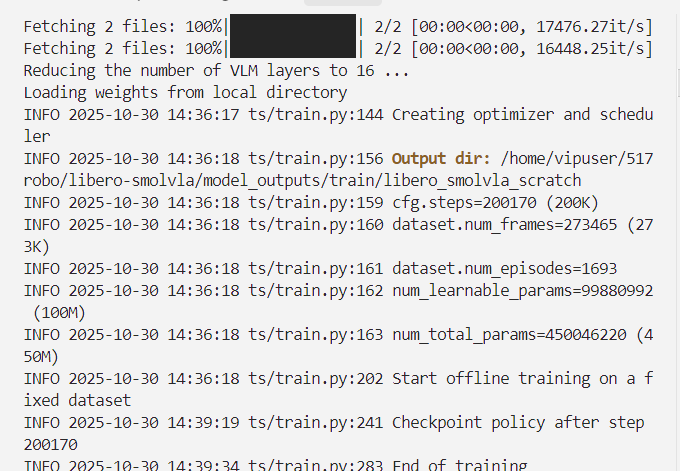
CUDA_VISIBLE_DEVICEs=“0” is used to solve issues in multi-GPU training. Additionally, I recommend increasing save_freq.
My training on the RTX 3090 is as follows:
Trained for about 10 hours.
The results reported by others above are good when over 60k steps. I stopped early because I wanted to test the evaluation script.
- Install LIBERO
The most difficult part is installing LIBERO.
Ignore the official installation script for LIBERO. These are the installation steps after my installation lerobot:
conda activate lerobot cd <LIBERO> pip install -e . pip install robosuite==1.4.0 pip install bddl pip install easydict pip install gym
- Use the following method to evaluate the script of @zlw21gxy
I will copy and paste it here again. I made some log changes.
python"""
This script demonstrates how to evaluate a pretrained smolVLA policy on the LIBERO benchmark.
https://github.com/huggingface/lerobot/issues/1316
"""

import collections
import dataclasses
import logging
import math
import pathlib
import os

import cv2
import draccus
import imageio
import numpy as np
import torch
from libero.libero import benchmark, get_libero_path
from libero.libero.envs import OffScreenRenderEnv
from tqdm import tqdm

from lerobot.policies.smolvla.modeling_smolvla import SmolVLAPolicy
torch.serialization.add_safe_globals([np.core.multiarray._reconstruct])
os.environ["TOKENIZERS_PARALLELISM"] = "false"

LIBERO_DUMMY_ACTION = [0.0] * 6 + [-1.0]
LIBERO_ENV_RESOLUTION = 256  # resolution used to render training data


def normalize_gripper_action(action, binarize=True):
    """
    Changes gripper action (last dimension of action vector) from [0,1] to [-1,+1].
    Necessary for some environments (not Bridge) because the dataset wrapper standardizes gripper actions to [0,1].
    Note that unlike the other action dimensions, the gripper action is not normalized to [-1,+1] by default by
    the dataset wrapper.

    Normalization formula: y = 2 * (x - orig_low) / (orig_high - orig_low) - 1
    """
    # Just normalize the last action to [-1,+1].
    orig_low, orig_high = 0.0, 1.0
    action[..., -1] = 2 * (action[..., -1] - orig_low) / (orig_high - orig_low) - 1

    if binarize:
        # Binarize to -1 or +1.
        action[..., -1] = np.sign(action[..., -1])

    return action


def invert_gripper_action(action):
    """
    Flips the sign of the gripper action (last dimension of action vector).
    This is necessary for some environments where -1 = open, +1 = close, since
    the RLDS dataloader aligns gripper actions such that 0 = close, 1 = open.
    """
    action[..., -1] = action[..., -1] * -1.0
    return action


@dataclasses.dataclass
class Args:
    """
    Evaluation arguments for smolVLA on LIBERO.
    """

    # --- Hugging Face arguments ---
    policy_path: str = "lerobot/smolvla_base"
    """Path to the pretrained policy on the Hugging Face Hub or local directory."""

    # --- LIBERO environment-specific parameters ---
    task_suite_name: str = "libero_spatial"
    """Task suite. Options: libero_spatial, libero_object, libero_goal, libero_10, libero_90"""
    num_steps_wait: int = 10
    """Number of steps to wait for objects to stabilize in sim."""
    num_trials_per_task: int = 1 #TODO:你可以修改这里
    """Number of rollouts per task."""

    # --- Evaluation arguments ---
    video_out_path: str = "data/libero/videos"
    """Path to save videos."""
    device: str = "cuda"
    """Device to use for evaluation."""

    seed: int = 7
    """Random Seed (for reproducibility)"""


@draccus.wrap()
def eval_libero(args: Args) -> None:
    # Set random seed
    torch.manual_seed(args.seed)
    np.random.seed(args.seed)

    # --- Load Policy ---
    policy = SmolVLAPolicy.from_pretrained(args.policy_path)
    policy.to(args.device)
    policy.eval()

    # --- Initialize LIBERO task suite ---
    benchmark_dict = benchmark.get_benchmark_dict()
    try:
        task_suite = benchmark_dict[args.task_suite_name]()
    except KeyError:
        raise ValueError(
            f"Unknown task suite: {args.task_suite_name}. "
            f"Available options are: {list(benchmark_dict.keys())}"
        )
    num_tasks_in_suite = task_suite.n_tasks
    logging.info(f"Task suite: {args.task_suite_name}")

    pathlib.Path(args.video_out_path).mkdir(parents=True, exist_ok=True)

    if args.task_suite_name == "libero_spatial":
        max_steps = 220  # longest training demo has 193 steps
    elif args.task_suite_name == "libero_object":
        max_steps = 280  # longest training demo has 254 steps
    elif args.task_suite_name == "libero_goal":
        max_steps = 300  # longest training demo has 270 steps
    elif args.task_suite_name == "libero_10":
        max_steps = 520  # longest training demo has 505 steps
    elif args.task_suite_name == "libero_90":
        max_steps = 400  # longest training demo has 373 steps
    else:
        # Fallback for custom task suites
        max_steps = 520

    # --- Evaluation Loop ---
    total_episodes, total_successes = 0, 0
    for task_id in tqdm(range(num_tasks_in_suite), desc="Tasks"):
        # Get task
        task = task_suite.get_task(task_id)

        # Get default LIBERO initial states
        initial_states = task_suite.get_task_init_states(task_id)

        # Initialize LIBERO environment and task description
        env, task_description = _get_libero_env(task, LIBERO_ENV_RESOLUTION, args.seed)

        # Start episodes
        task_episodes, task_successes = 0, 0
        for episode_idx in tqdm(
            range(min(args.num_trials_per_task, len(initial_states))),
            desc=f"Task {task_id}: {task.language}",
            leave=False,
        ):
            logging.info(f"\nTask: {task_description}")

            # Reset environment and policy
            env.reset()
            policy.reset()

            # Set initial states
            obs = env.set_init_state(initial_states[episode_idx])

            # IMPORTANT: Do nothing for the first few timesteps because the simulator drops objects
            # and we need to wait for them to fall
            for _ in range(args.num_steps_wait):
                obs, _, _, _ = env.step(LIBERO_DUMMY_ACTION)

            # Setup
            t = 0
            frames = []
            done = False

            # Add initial frame
            agentview_image = np.ascontiguousarray(obs["agentview_image"][::-1, ::-1])
            # frames.append(agentview_image)
            # import ipdb; ipdb.set_trace()
            logging.info(f"Starting episode {task_episodes+1}...")
            while t < max_steps:
                try:
                    # Get preprocessed image
                    # IMPORTANT: rotate 180 degrees to match train preprocessing
                    wrist_img = np.ascontiguousarray(obs["robot0_eye_in_hand_image"][::-1, ::-1])
                    agentview_image = np.ascontiguousarray(obs["agentview_image"][::-1, ::-1])
                    frames.append(agentview_image)

                    # Prepare observations dict
                    state = np.concatenate(
                        (
                            obs["robot0_eef_pos"],
                            _quat2axisangle(obs["robot0_eef_quat"]),
                            obs["robot0_gripper_qpos"],
                        )
                    )
                    observation = {
                        "observation.images.image": torch.from_numpy(agentview_image / 255.0)
                        .permute(2, 0, 1)
                        .to(torch.float32)
                        .to(args.device).unsqueeze(0),
                        "observation.images.wrist_image": torch.from_numpy(wrist_img / 255.0)
                        .permute(2, 0, 1)
                        .to(torch.float32)
                        .to(args.device).unsqueeze(0),
                        "observation.state": torch.from_numpy(state).to(torch.float32).to(args.device).unsqueeze(0),
                        "task": task_description,
                    }

                    # Query model to get action
                    with torch.inference_mode():
                        action_tensor = policy.select_action(observation)
                    action = action_tensor.cpu().numpy()[0]
                    # action[-1] = 1 - action[-1]
                    action = normalize_gripper_action(action, binarize=False)
                    action = invert_gripper_action(action)

                    # Execute action in environment
                    obs, _, done, _ = env.step(action)
                    if done:
                        task_successes += 1
                        total_successes += 1
                        break
                    t += 1

                except Exception as e:
                    logging.error(f"Caught exception: {e}")
                    break

            task_episodes += 1
            total_episodes += 1

            # Save a replay video of the episode
            suffix = "success" if done else "failure"
            task_segment = task_description.replace(" ", "_").replace("/", "_")
            video_path = (
                pathlib.Path(args.video_out_path) / f"rollout_task_{task_id}_episode_{episode_idx}_{task_segment}_{suffix}.mp4"
            )
            fps = 30
            writer = imageio.get_writer(video_path, fps=fps)

            for image in frames:
                writer.append_data(image)
            writer.close()
            logging.info(f"Saved video to {video_path}")
            # import ipdb; ipdb.set_trace()

            # Log current results
            logging.info(f"Success: {done}")
            if total_episodes > 0:
                logging.info(f"# episodes completed so far: {total_episodes}")
                logging.info(f"# successes: {total_successes} ({total_successes / total_episodes * 100:.1f}%)")

        # Log final results for the task
        if task_episodes > 0:
            logging.info(f"Task {task_id} success rate: {float(task_successes) / float(task_episodes):.2f}")
        if total_episodes > 0:
            logging.info(f"Cumulative success rate: {float(total_successes) / float(total_episodes):.2f}")

    logging.info("--- Evaluation finished ---")
    if total_episodes > 0:
        logging.info(f"Total success rate: {float(total_successes) / float(total_episodes):.2f}")
    logging.info(f"Total episodes: {total_episodes}")
    logging.info(f"Total successes: {total_successes}")
    # cv2.destroyAllWindows()


def _get_libero_env(task, resolution, seed):
    """Initializes and returns the LIBERO environment, along with the task description."""
    task_description = task.language
    task_bddl_file = pathlib.Path(get_libero_path("bddl_files")) / task.problem_folder / task.bddl_file
    env_args = {
        "bddl_file_name": str(task_bddl_file),
        "camera_heights": resolution,
        "camera_widths": resolution,
    }
    env = OffScreenRenderEnv(**env_args)
    env.seed(seed)  # IMPORTANT: seed seems to affect object positions even when using fixed initial state
    return env, task_description


def _quat2axisangle(quat):
    """
    Copied from robosuite:
    https://github.com/ARISE-Initiative/robosuite/blob/eafb81f54ffc104f905ee48a16bb15f059176ad3/robosuite/utils/transform_utils.py#L490C1-L512C55
    """
    # clip quaternion
    if quat[3] > 1.0:
        quat[3] = 1.0
    elif quat[3] < -1.0:
        quat[3] = -1.0

    den = np.sqrt(1.0 - quat[3] * quat[3])
    if math.isclose(den, 0.0):
        # This is (close to) a zero degree rotation, immediately return
        return np.zeros(3)

    return (quat[:3] * 2.0 * math.acos(quat[3])) / den


if __name__ == "__main__":
    logging.basicConfig(
        level=logging.INFO,
        format="%(asctime)s - %(levelname)s - %(message)s",
        handlers=[
            logging.FileHandler("evaluation_log.txt"),
            logging.StreamHandler()  # Optional: keeps logging in the terminal too
        ]
    )
    eval_libero()
The script for task number 1 is as follows:
"""
This script demonstrates how to evaluate a pretrained smolVLA policy on the LIBERO benchmark.
https://github.com/huggingface/lerobot/issues/1316
"""

import collections
import dataclasses
import logging
import math
import pathlib
import os
from typing import Optional

import cv2
import draccus
import imageio
import numpy as np
import torch
from libero.libero import benchmark, get_libero_path
from libero.libero.envs import OffScreenRenderEnv
from tqdm import tqdm

from lerobot.policies.smolvla.modeling_smolvla import SmolVLAPolicy
torch.serialization.add_safe_globals([np.core.multiarray._reconstruct])
os.environ["TOKENIZERS_PARALLELISM"] = "false"

LIBERO_DUMMY_ACTION = [0.0] * 6 + [-1.0]
LIBERO_ENV_RESOLUTION = 256  # resolution used to render training data


def normalize_gripper_action(action, binarize=True):
    """
    Changes gripper action (last dimension of action vector) from [0,1] to [-1,+1].
    Necessary for some environments (not Bridge) because the dataset wrapper standardizes gripper actions to [0,1].
    Note that unlike the other action dimensions, the gripper action is not normalized to [-1,+1] by default by
    the dataset wrapper.

    Normalization formula: y = 2 * (x - orig_low) / (orig_high - orig_low) - 1
    """
    # Just normalize the last action to [-1,+1].
    orig_low, orig_high = 0.0, 1.0
    action[..., -1] = 2 * (action[..., -1] - orig_low) / (orig_high - orig_low) - 1

    if binarize:
        # Binarize to -1 or +1.
        action[..., -1] = np.sign(action[..., -1])

    return action


def invert_gripper_action(action):
    """
    Flips the sign of the gripper action (last dimension of action vector).
    This is necessary for some environments where -1 = open, +1 = close, since
    the RLDS dataloader aligns gripper actions such that 0 = close, 1 = open.
    """
    action[..., -1] = action[..., -1] * -1.0
    return action


@dataclasses.dataclass
class Args:
    """
    Evaluation arguments for smolVLA on LIBERO.
    """

    # --- Hugging Face arguments ---
    policy_path: str = "lerobot/smolvla_base"
    """Path to the pretrained policy on the Hugging Face Hub or local directory."""

    # --- LIBERO environment-specific parameters ---
    task_suite_name: str = "libero_spatial"
    """Task suite. Options: libero_spatial, libero_object, libero_goal, libero_10, libero_90"""
    num_steps_wait: int = 10
    """Number of steps to wait for objects to stabilize in sim."""
    num_trials_per_task: int = 10 #TODO:你可以修改这里
    """Number of rollouts per task."""

    # --- Evaluation arguments ---
    video_out_path: str = "data/libero/videos_task1"
    """Path to save videos."""
    device: str = "cuda"
    """Device to use for evaluation."""

    seed: int = 7
    """Random Seed (for reproducibility)"""

    specific_task_id: Optional[int] = 1 # TODO: 你可以修改这里更改任务
    """Specific task ID to run (if None, runs all tasks). For task1, set to 1."""


@draccus.wrap()
def eval_libero(args: Args) -> None:
    # Set random seed
    torch.manual_seed(args.seed)
    np.random.seed(args.seed)

    # --- Load Policy ---
    policy = SmolVLAPolicy.from_pretrained(args.policy_path)
    policy.to(args.device)
    policy.eval()

    # --- Initialize LIBERO task suite ---
    benchmark_dict = benchmark.get_benchmark_dict()
    try:
        task_suite = benchmark_dict[args.task_suite_name]()
    except KeyError:
        raise ValueError(
            f"Unknown task suite: {args.task_suite_name}. "
            f"Available options are: {list(benchmark_dict.keys())}"
        )
    num_tasks_in_suite = task_suite.n_tasks
    logging.info(f"Task suite: {args.task_suite_name}")

    pathlib.Path(args.video_out_path).mkdir(parents=True, exist_ok=True)

    if args.task_suite_name == "libero_spatial":
        max_steps = 220  # longest training demo has 193 steps
    elif args.task_suite_name == "libero_object":
        max_steps = 280  # longest training demo has 254 steps
    elif args.task_suite_name == "libero_goal":
        max_steps = 300  # longest training demo has 270 steps
    elif args.task_suite_name == "libero_10":
        max_steps = 520  # longest training demo has 505 steps
    elif args.task_suite_name == "libero_90":
        max_steps = 400  # longest training demo has 373 steps
    else:
        # Fallback for custom task suites
        max_steps = 520

    # --- Evaluation Loop ---
    total_episodes, total_successes = 0, 0

    # Determine which tasks to run
    if args.specific_task_id is not None:
        if args.specific_task_id >= num_tasks_in_suite:
            raise ValueError(f"Task ID {args.specific_task_id} is out of range. Available tasks: 0-{num_tasks_in_suite-1}")
        task_ids = [args.specific_task_id]
        logging.info(f"Running only task {args.specific_task_id}")
    else:
        task_ids = list(range(num_tasks_in_suite))
        logging.info(f"Running all {num_tasks_in_suite} tasks")

    for task_id in tqdm(task_ids, desc="Tasks"):
        # Get task
        task = task_suite.get_task(task_id)

        # Get default LIBERO initial states
        initial_states = task_suite.get_task_init_states(task_id)

        # Initialize LIBERO environment and task description
        env, task_description = _get_libero_env(task, LIBERO_ENV_RESOLUTION, args.seed)

        # Start episodes
        task_episodes, task_successes = 0, 0
        for episode_idx in tqdm(
            range(min(args.num_trials_per_task, len(initial_states))),
            desc=f"Task {task_id}: {task.language}",
            leave=False,
        ):
            logging.info(f"\nTask: {task_description}")

            # Reset environment and policy
            env.reset()
            policy.reset()

            # Set initial states
            obs = env.set_init_state(initial_states[episode_idx])

            # IMPORTANT: Do nothing for the first few timesteps because the simulator drops objects
            # and we need to wait for them to fall
            for _ in range(args.num_steps_wait):
                obs, _, _, _ = env.step(LIBERO_DUMMY_ACTION)

            # Setup
            t = 0
            frames = []
            done = False

            # Add initial frame
            agentview_image = np.ascontiguousarray(obs["agentview_image"][::-1, ::-1])
            # frames.append(agentview_image)
            # import ipdb; ipdb.set_trace()
            logging.info(f"Starting episode {task_episodes+1}...")
            while t < max_steps:
                try:
                    # Get preprocessed image
                    # IMPORTANT: rotate 180 degrees to match train preprocessing
                    wrist_img = np.ascontiguousarray(obs["robot0_eye_in_hand_image"][::-1, ::-1])
                    agentview_image = np.ascontiguousarray(obs["agentview_image"][::-1, ::-1])
                    frames.append(agentview_image)

                    # Prepare observations dict
                    state = np.concatenate(
                        (
                            obs["robot0_eef_pos"],
                            _quat2axisangle(obs["robot0_eef_quat"]),
                            obs["robot0_gripper_qpos"],
                        )
                    )
                    observation = {
                        "observation.images.image": torch.from_numpy(agentview_image / 255.0)
                        .permute(2, 0, 1)
                        .to(torch.float32)
                        .to(args.device).unsqueeze(0),
                        "observation.images.wrist_image": torch.from_numpy(wrist_img / 255.0)
                        .permute(2, 0, 1)
                        .to(torch.float32)
                        .to(args.device).unsqueeze(0),
                        "observation.state": torch.from_numpy(state).to(torch.float32).to(args.device).unsqueeze(0),
                        "task": task_description,
                    }

                    # Query model to get action
                    with torch.inference_mode():
                        action_tensor = policy.select_action(observation)
                    action = action_tensor.cpu().numpy()[0]
                    # action[-1] = 1 - action[-1]
                    action = normalize_gripper_action(action, binarize=False)
                    action = invert_gripper_action(action)

                    # Execute action in environment
                    obs, _, done, _ = env.step(action)
                    if done:
                        task_successes += 1
                        total_successes += 1
                        break
                    t += 1

                except Exception as e:
                    logging.error(f"Caught exception: {e}")
                    break

            task_episodes += 1
            total_episodes += 1

            # Save a replay video of the episode
            suffix = "success" if done else "failure"
            task_segment = task_description.replace(" ", "_").replace("/", "_")
            video_path = (
                pathlib.Path(args.video_out_path) / f"rollout_task_{task_id}_episode_{episode_idx}_{task_segment}_{suffix}.mp4"
            )
            fps = 30
            writer = imageio.get_writer(video_path, fps=fps)

            for image in frames:
                writer.append_data(image)
            writer.close()
            logging.info(f"Saved video to {video_path}")
            # import ipdb; ipdb.set_trace()

            # Log current results
            logging.info(f"Success: {done}")
            if total_episodes > 0:
                logging.info(f"# episodes completed so far: {total_episodes}")
                logging.info(f"# successes: {total_successes} ({total_successes / total_episodes * 100:.1f}%)")

        # Log final results for the task
        if task_episodes > 0:
            logging.info(f"Task {task_id} success rate: {float(task_successes) / float(task_episodes):.2f}")
        if total_episodes > 0:
            logging.info(f"Cumulative success rate: {float(total_successes) / float(total_episodes):.2f}")

    logging.info("--- Evaluation finished ---")
    if total_episodes > 0:
        logging.info(f"Total success rate: {float(total_successes) / float(total_episodes):.2f}")
    logging.info(f"Total episodes: {total_episodes}")
    logging.info(f"Total successes: {total_successes}")
    # cv2.destroyAllWindows()


def _get_libero_env(task, resolution, seed):
    """Initializes and returns the LIBERO environment, along with the task description."""
    task_description = task.language
    task_bddl_file = pathlib.Path(get_libero_path("bddl_files")) / task.problem_folder / task.bddl_file
    env_args = {
        "bddl_file_name": str(task_bddl_file),
        "camera_heights": resolution,
        "camera_widths": resolution,
    }
    env = OffScreenRenderEnv(**env_args)
    env.seed(seed)  # IMPORTANT: seed seems to affect object positions even when using fixed initial state
    return env, task_description


def _quat2axisangle(quat):
    """
    Copied from robosuite:
    https://github.com/ARISE-Initiative/robosuite/blob/eafb81f54ffc104f905ee48a16bb15f059176ad3/robosuite/utils/transform_utils.py#L490C1-L512C55
    """
    # clip quaternion
    if quat[3] > 1.0:
        quat[3] = 1.0
    elif quat[3] < -1.0:
        quat[3] = -1.0

    den = np.sqrt(1.0 - quat[3] * quat[3])
    if math.isclose(den, 0.0):
        # This is (close to) a zero degree rotation, immediately return
        return np.zeros(3)

    return (quat[:3] * 2.0 * math.acos(quat[3])) / den


if __name__ == "__main__":
    logging.basicConfig(
        level=logging.INFO,
        format="%(asctime)s - %(levelname)s - %(message)s",
        handlers=[
            logging.FileHandler("evaluation_log.txt"),
            logging.StreamHandler()  # Optional: keeps logging in the terminal too
        ]
    )
    eval_libero()
To run this script, please use:
export OUTPUT_ROOT=/path/to/outputs

python eval_LIBERO.py --policy_path="$OUTPUT_ROOT/libero_smolvla_scratch/checkpoints/140000/pretrained_model/"

python eval_LIBERO.py --policy_path="$OUTPUT_ROOT/libero_smolvla_scratch/checkpoints/130000/pretrained_model/"

python eval_LIBERO.py --policy_path="$OUTPUT_ROOT/libero_smolvla_scratch/checkpoints/200000/pretrained_model/"

python eval_LIBERO.py --policy_path="$OUTPUT_ROOT/libero_smolvla_scratch/checkpoints/200170/pretrained_model/"

python eval_LIBERO-task1.py --policy_path="$OUTPUT_ROOT/libero_smolvla_scratch/checkpoints/200170/pretrained_model/"


python eval_LIBERO.py --policy_path="$OUTPUT_ROOT/libero_smolvla_scratch/checkpoints/200340/pretrained_model/"

python eval_LIBERO-task1.py --policy_path="$OUTPUT_ROOT/libero_smolvla_scratch/checkpoints/200340/pretrained_model/"


python eval_LIBERO-task1-libero10.py --policy_path="$OUTPUT_ROOT/libero_smolvla_scratch/checkpoints/200340/pretrained_model/"
If you encounter this error:
File “/home/tay/Documents/robo-intel-action/finetuning_lerobot/LIBERO/libero/libero/benchmark/__init__.py”, line 164, in get_task_init_states init_states = torch.load(init_states_path) File “/home/tay/miniconda3/envs/lerobot/lib/python3.10/site-packages/torch/serialization.py”, line 1524, in load raise pickle.UnpicklingError(_get_wo_message(str(e))) from None _pickle.UnpicklingError: Weights only load failed. This file can still be loaded, to do so you have two options, do those steps only if you trust the source of the checkpoint.
libero.benchmark.__init__.py will change line 164 from the following content:
init_states = torch.load(init_states_path)
Regarding this:
init_states = torch.load(init_states_path, weights_only=False) 4. Result
The evaluation script outputs some deployment and statistics in the terminal (I output them to evaluation_log.txt).
2025-08-07 10:49:34,622 - INFO - — Evaluation finished — 2025-08-07 10:49:34,622 - INFO - Total success rate: 0.71 2025-08-07 10:49:34,622 - INFO - Total episodes: 500 2025-08-07 10:49:34,622 - INFO - Total successes: 356
Release Task 9 Episode 47: Place the black bowl on the wooden cabinet and on the plate successfully.mp4 Release Task 3 Episode 26: Pick up the black bowl from the cookie box and place it on the plate successfully.mp4