
Task 02: Technical Analysis
1. Why this section is important
Many learners quickly encounter several common terms when they first come into contact with embodied AI: VLA, world model, VLM, behavior base model, and end-to-cloud collaboration. The issue is that these terms are often listed together in news reports and project introductions, but when starting to learn, beginners often don’t clearly understand the relationship between them. For example, are VLA and world model the same thing? Is RynnBrain a motion model, or a model that is more aligned with “embodied brain” concepts? Why do some robot tasks emphasize end-to-end action prediction, while others focus on internal modeling and reasoning?
The goal of this section is to transform these concepts from mere “hotly discussed” terms into tools that can actually help us understand the model structure. After reading this section, you don’t need to master all the details of the paper immediately, but at least you should develop a consistent understanding: which methods are more like “doing it directly after seeing it,” and which ones are more like “first forming an understanding of the environment internally, then deciding how to act.” Moreover, RynnBrain, as emphasized by the DAMO Academy in this topic, how connects “understanding the scene,” “understanding the space,” and “planning actions.”
2. From Traditional Control to Embodied Large Models
The embodied system can be viewed as a basic closed loop first:
flowchart LR
    A["感知 Perception"] --> B["理解与推理 Cognition"]
    B --> C["规划与决策 Planning"]
    C --> D["动作执行 Action"]
    D --> E["环境反馈 Feedback"]
    E --> A
In the past, many robot systems relied on rule-based control, traditional planners, and specialized policy networks. They often performed reliably for certain tasks, but had limited transfer capabilities, and it was also difficult to directly understand natural language instructions. In recent years, with the emergence of large models in the field of embodied AI, a significant change has occurred: the originally highly fragmented modules of perception, understanding, planning, and action have begun to be organized into a more unified framework. For this reason, when discussing embodied AI today, people no longer focus solely on controllers and planners, but instead discuss the model paradigm itself.
3. What is VLA
VLA is the abbreviation for Vision-Language-Action. The simplest way to understand it is: it aims to integrate visual input, language commands, and action outputs into a unified model, allowing the system to directly move from “what I see and what I am asked to do” to “what I should do next”.
Provide the model with an image, a text instruction, and some information about the robot’s own state, so that it can directly predict the next action or action sequence.
From a task perspective, VLA attempts to address three aspects simultaneously. First, it extracts environmental information relevant to the task from images or videos. Second, it understands the goals and constraints in language—such as what exactly is required to “put eggplants into a bowl” and where to place them. Third, it combines the previous two aspects into executable action representations. This is why VLA has rapidly become one of the core keywords in the field of embodied AI in the past two years, as it closely aligns with the intuitive scenario of “a robot understanding a sentence and actually performing it.”
3.1 Basic Working Mode of VLA
flowchart LR
    A["视觉输入\n相机图像 / 视频"] --> D["统一模型"]
    B["语言输入\n任务指令"] --> D
    C["机器人状态\n关节角 / 末端位姿 / 触觉等"] --> D
    D --> E["动作输出\nAction Token / 连续动作 / 动作块"]
3.2 Why VLA is Important
The importance of VLA lies not in simply combining three words, but in how it organizes “see, understand, and act” into a unified training and reasoning task. The benefits are obvious: on one hand, it is naturally suitable for language-driven robot manipulation tasks; on the other hand, it makes it easier to learn relatively general skill representations from multi-task demonstration data. For learners, the value of VLA lies in compressing previously scattered issues into a more intuitive framework.
3.3 Typical Limitations of VLA
But VLA is by no means a solution where “once implemented, everything is fine”. Its most common problem stems from the complexity of the real world. First, it is usually sensitive to the distribution of training data; tasks with more exposure are learned quickly, while unseen details tend to cause issues. Second, many VLA models accumulate errors in long-term sequential tasks, as a deviation in a single step often affects all subsequent steps. Third, although the model can learn a lot from images, its explicit modeling of three-dimensional spatial structures, physical constraints, and contact relationships is often insufficient. It is precisely due to these limitations that researchers continue to explore world models, explicit spatial representations, and more robust planning mechanisms.
3.4 Official Diagram: OpenVLA
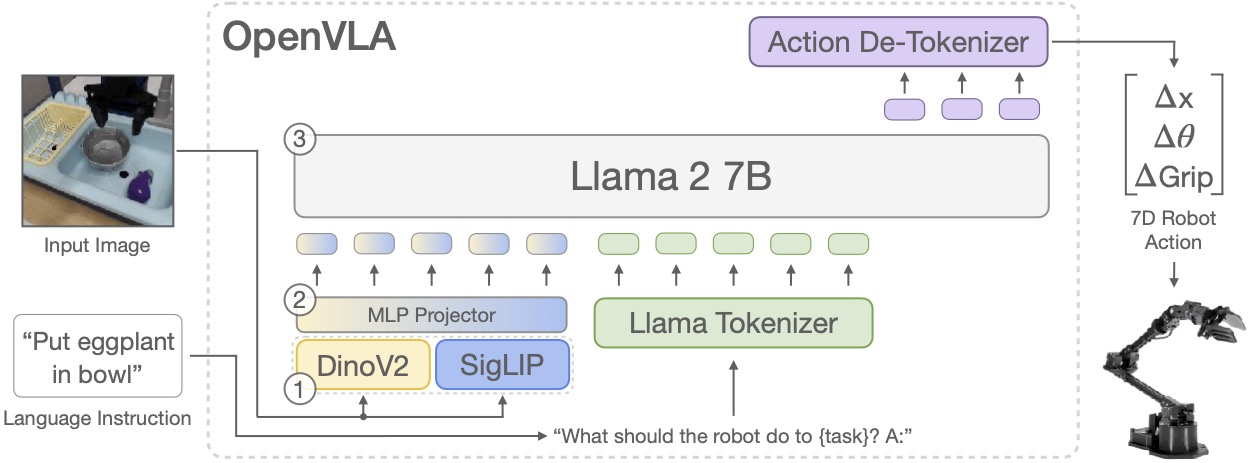
Schematic Diagram of OpenVLA Architecture
Source: OpenVLA Official Project Page
If this OpenVLA architecture diagram is treated as a “teaching diagram,” the most important thing is not to remember the names of each module, but to understand its data flow. On the left side of the diagram are inputs: above is a scene image, and below is a natural language instruction, such as “put eggplant in a bowl.” In the middle is the model主体, and at the bottom can be seen two visual modules: DinoV2 and SigLIP, which extract different types of visual features from the image. These visual features are projected through MLP Projector and organized into a format suitable for being fed into Llama 2 7B. At the same time, the language instruction is also encoded into language tokens through the tokenizer. Ultimately, the visual tokens and language tokens participate in reasoning within the same large language model framework.
The most notable feature in the figure is Action De-Tokenizer in the upper right corner. This indicates that OpenVLA does not directly output motor control signals to Llama 2, but first converts the actions into tokens that can be predicted by the model, and then reverses these tokens back into the robot’s 7-dimensional actions, such as position increments, angle increments, and gripper opening and closing. In other words, this figure clearly illustrates the core concept of VLA: first unifying what is “seen” and “heard” into tokens that the model can process, and then translating the model’s output back into actions that the robot can execute.
The 1-2-3 marked in the diagram is also very suitable for helping beginners understand the entire process. 1 corresponds to the visual encoding stage, which is the extraction of semantic and spatial features from images; 2 corresponds to the feature alignment stage, which is the mapping of visual information into a representation space acceptable by the language model; 3 corresponds to the unified reasoning stage, which is where vision and language jointly determine the next action within the same backbone model. This is the best explanation for why “VLA” is called a visual-language-action integrated model.
3.5 Further Reading
- VLA Overview and Model Lineage: 01VLA-related summary overview
4. What is a world model
If the VLA emphasizes “taking action immediately after seeing a command,” then the world model emphasizes “first forming predictions about environmental changes internally, and then planning actions based on those predictions.” This difference is crucial, as it corresponds to two different views of intelligence.
First, establish a prediction mechanism for environmental changes internally, and then plan actions based on it.
You can think of it as a robot “practicing inside its mind first”.
4.1 What is the world model actually building
The world model typically attempts to model three types of relationships: what the current environment state is, how the environment will change after a certain action is performed, and which path among several possible future developments is closer to the goal. For robots, this is equivalent to mentally “imagining” what will happen next before taking real action. It is not a simple reaction system, but rather a decision-making system with an internal simulator.
4.2 Core Values of the World Model
The world model is valued by many researchers because tasks in the real world are often not completed in one step. Before grasping an object, a robotic arm needs to determine the orientation of the object and surrounding obstacles. The navigation system must estimate the feasible path a few seconds later. When two robotic arms collaborate, the timing coupling between actions must also be considered. In these tasks, simply outputting what is seen can easily lead to errors, while internal prediction can significantly improve planning capabilities.
4.3 A Simple Illustration of the World Model for Understanding
flowchart LR
    A["当前观测 o_t"] --> B["状态表示 / 潜变量 s_t"]
    B --> C["世界模型\n预测下一状态"]
    D["动作 a_t"] --> C
    C --> E["预测的未来状态 s_t+1"]
    E --> F["规划器 / 价值判断"]
    F --> G["选择更优动作"]
    G --> D
4.4 Why Many People Consider the World Model to Be Very Important
The real world is not a static image, but a system that continues to evolve. Objects move, the order of actions changes the subsequent state, and early errors in multi-step tasks continue to worsen. The value of a world model lies in its ability to handle problems where “actions change the world.” For this reason, many researchers understand a world model as a key direction for embodied AI to transition from “reaction-based systems” to “planning-based systems”.
5. What is the difference between VLA and the world model?
You can first use the table below to separate the concepts. When reading the table, don’t interpret it as a simple choice between two options; instead, consider it as a comparison of the two modeling focuses:
| Dimension | VLA | World model |
|---|---|---|
| Core Goal | Generate actions directly from vision/language | Explicitly predict environmental evolution and assist planning |
| Strengths | Instruction understanding, multi-task mapping, end-to-end integration | Long-term temporal reasoning, state prediction, planning |
| Common Issues | Accumulation of long-chain errors, insufficient spatial/physical modeling | Complex training, difficulty in state representation and planning |
| Similar To | “Do it directly after seeing” | “Think through it first before acting” |
In real-world systems, these two approaches are not mutually exclusive. More and more work will utilize both end-to-end action prediction and internal world modeling within a unified system. In other words, VLA and world model are not mutually exclusive labels, but rather complementary technical approaches.
6. Damo Institute RynnBrain: Why It Matters Separately
RynnBrain is more suitable to be understood as part of the “VLM + world model enhancement” framework. Rather than considering it as a model solely responsible for outputting actions, it can be seen as a more “embodied brain” system: it not only identifies and responds, but also locates, understands, reasons, and organizes tasks.
6.1 Official Architecture Diagram
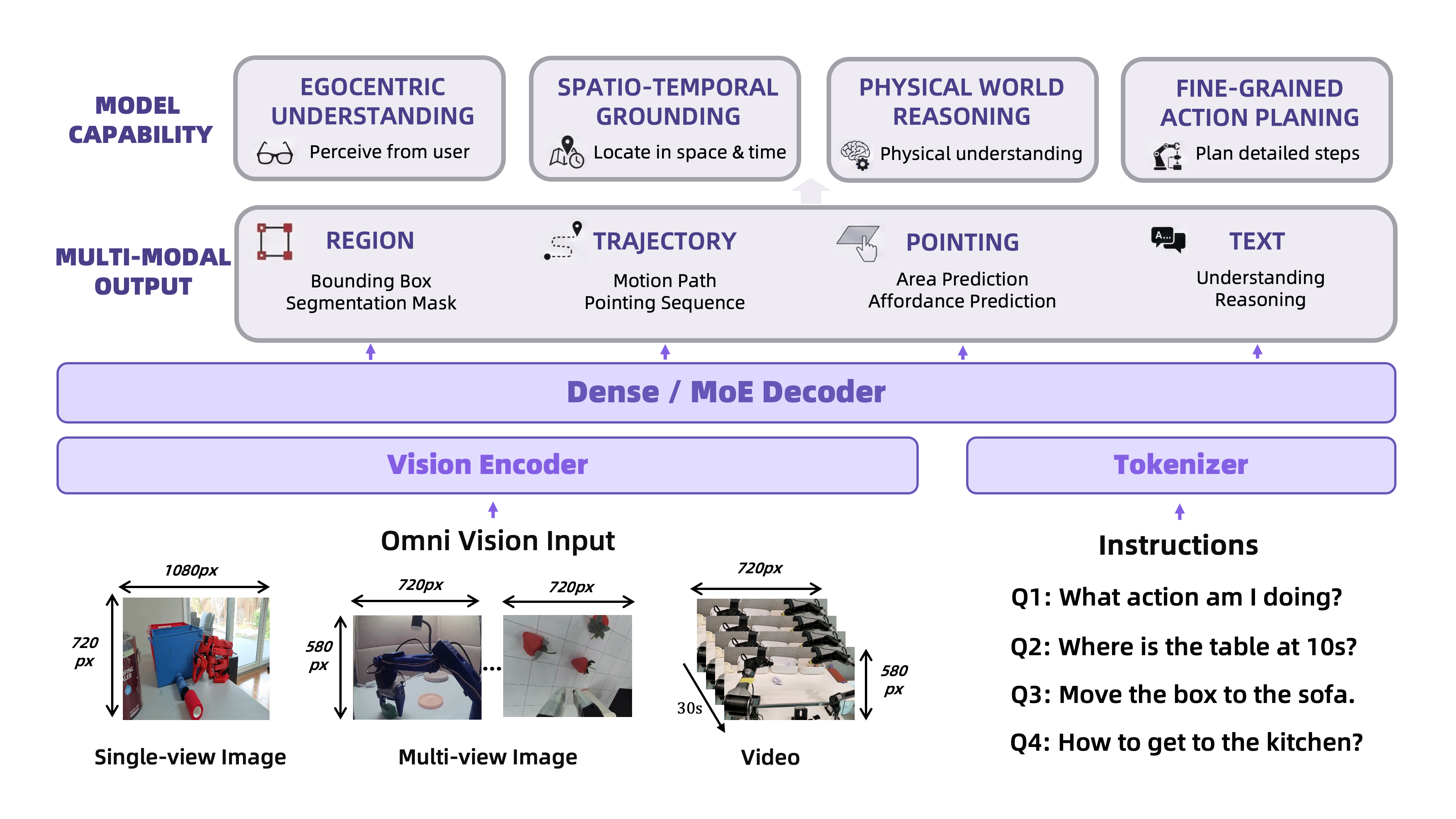
RynnBrain Official Architecture Diagram
Source: RynnBrain official project page
This diagram is ideal for in-depth analysis. At the bottom is the input layer; on the left, Omni Vision Input indicates three types of visual inputs: single-view images, multi-view images, and videos. On the right are the command inputs, such as “What action am I performing?” “Where is the table at 10 seconds?” “Move the box to the sofa.” These examples implicitly show that RynnBrain is not focused on a single task, but rather on various embodied problems such as recognition, positioning, manipulation, and navigation.
At a higher level are Vision Encoder and Tokenizer. This indicates that RynnBrain first encodes visual information and language instructions separately, and then sends them to a large intermediate decoder. The widest Dense / MoE Decoder in the middle is the core of the entire system. It shows that the system does not simply produce a single output, but supports multiple downstream capabilities within a unified decoding framework. The “multimodal output” section in the middle of the diagram is particularly noteworthy. It is not a single action vector, but is divided into four forms: Region, Trajectory, Pointing, and Text. In other words, RynnBrain’s output can be either the bounding box and segmentation mask of the target region, or the trajectory and pointing area, or even the understanding and reasoning results at the text layer.
The Model Capability at the top further explains what problem this multimodal output aims to solve. Egocentric Understanding corresponds to first-person perspective understanding, indicating that the model can comprehend the scenario from the user’s viewpoint; Spatio-Temporal Grounding emphasizes spatial and temporal positioning capabilities, showing that it knows not only “what” but also “where and when”; Physical World Reasoning highlights physical world understanding, meaning that the model’s reasoning does not remain at an abstract semantic level, but is integrated with objects, spaces, and action constraints; Fine-Grained Action Planning indicates that it ultimately needs to return to fine-grained action planning. In this way, this diagram clearly defines RynnBrain: it is not a simple Q&A model, nor a simple action model, but a embodied foundational model that integrates understanding, positioning, reasoning, and planning.
Precisely because of this, the difference between RynnBrain and ordinary VLA can be more accurately described as follows: ordinary VLA emphasizes a unified mapping from current input to action output, while RynnBrain focuses on scene organization across time, explicit positioning of spatial objects, and the task scheduling capabilities that are supported by this. For beginners, it is sufficient to remember just three key terms: “spatiotemporal memory,” “spatial reasoning,” and “task scheduling.”
Project Demo Demonstration
6.2 Experience RynnBrain Model
RynnBrain is a embodied brain with physical perception capabilities: it can observe scenes from the first-person perspective, anchor language in physical space and time, and provide reliable positioning and planning outputs for downstream robot systems.
👉🏻 Experience link: RynnBrain model experience
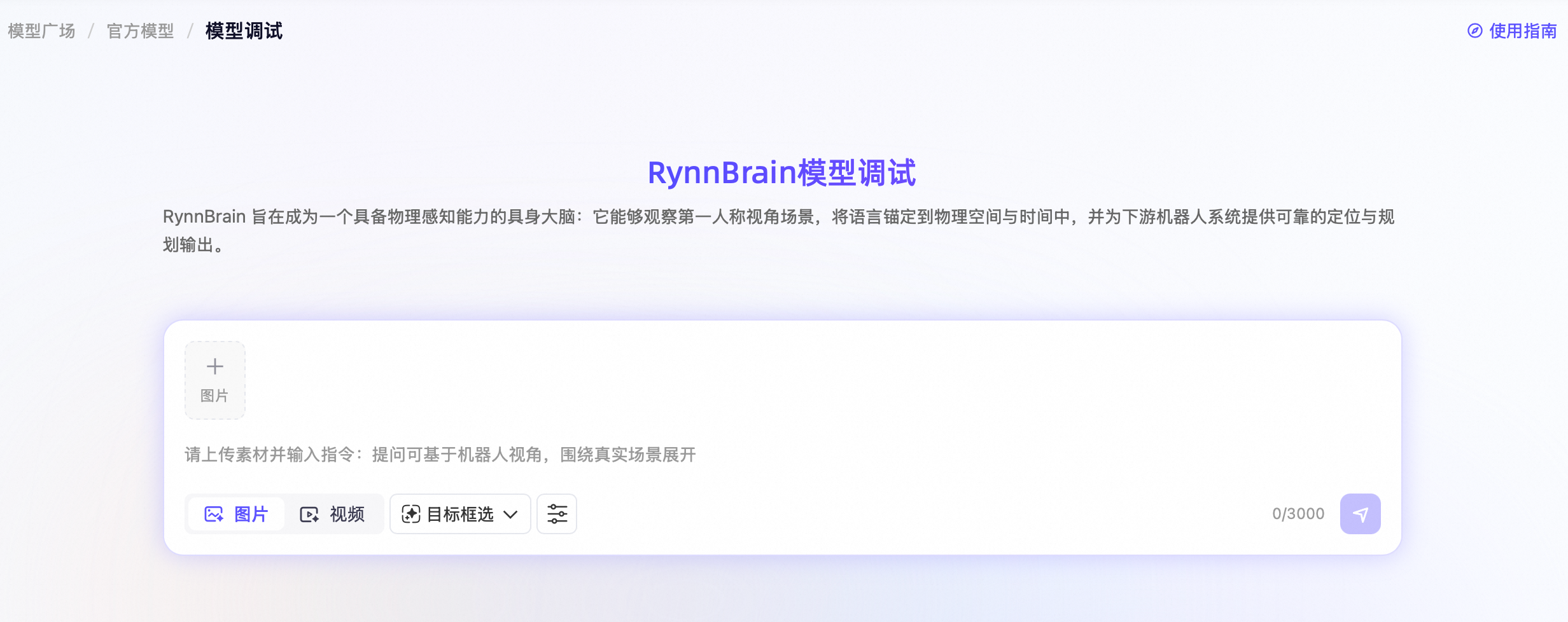
Now, you can take a picture or upload a video of a real environment, allowing RynnBrain to perform general Q&A, operability detection, target selection, trajectory prediction, and area prediction from a first-person perspective.
| Capability | Description |
|---|---|
| General Q&A | Suitable for regular conversations and open-ended questions. The model will make flexible judgments based on instructions, directly responding with text or applying corresponding visual markers on images |
| Manipulation Point Detection | Identifies the most suitable interaction points on objects, and marks prominent highlight dots at corresponding positions on images to clearly indicate the operation points |
| Target Selection | Locates target objects according to instructions, and draws rectangular borders on images to enclose these objects, clearly defining the target range |
| Trajectory Prediction | Plans the movement path of objects from the starting point to the ending point based on instructions, and marks key points along the path on images, visually displaying the object’s movement trajectory |
| Area Prediction | Identifies specific regions in the image that meet the conditions, and distributes multiple key points within these regions, clearly showing the effective range of the space |
| Example 1: Target Selection | |
|---|---|
Take a photo of a home kitchen and let the robot identify it from a first-person perspective. Prompt: Find the mineral water on the table. 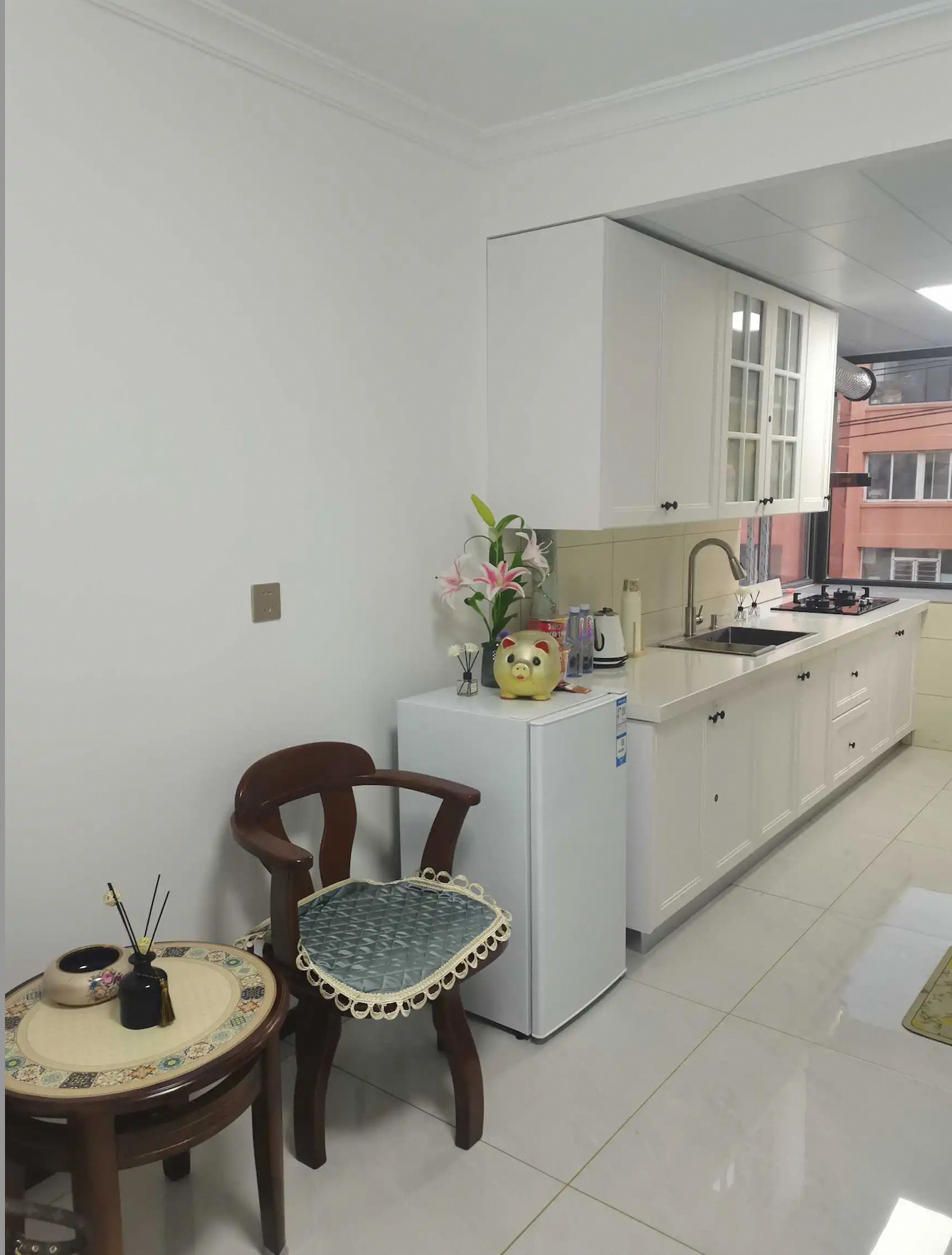 |
Response: RynnBrain combines scene recognition to identify the mineral water on the table and mark it. 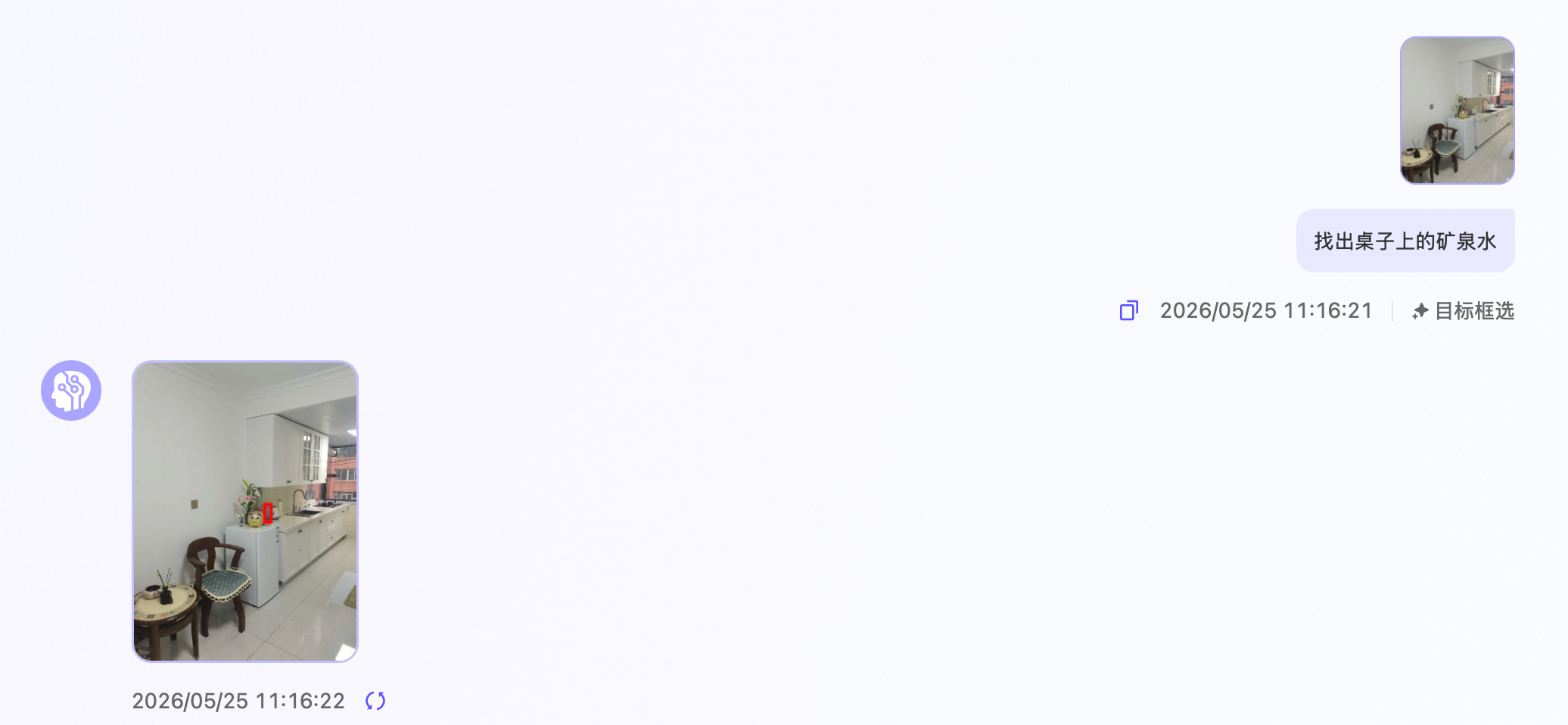 |
| Example 2: Trajectory Prediction | |
| Take a photo of a home living room and let the robot identify it from a first-person perspective. Prompt: Put the mineral water on the TV cabinet into the trash can | Response: RynnBrain combines scene recognition to identify the mineral water on the TV cabinet and the trash can next to it, and marks the movement trajectory. 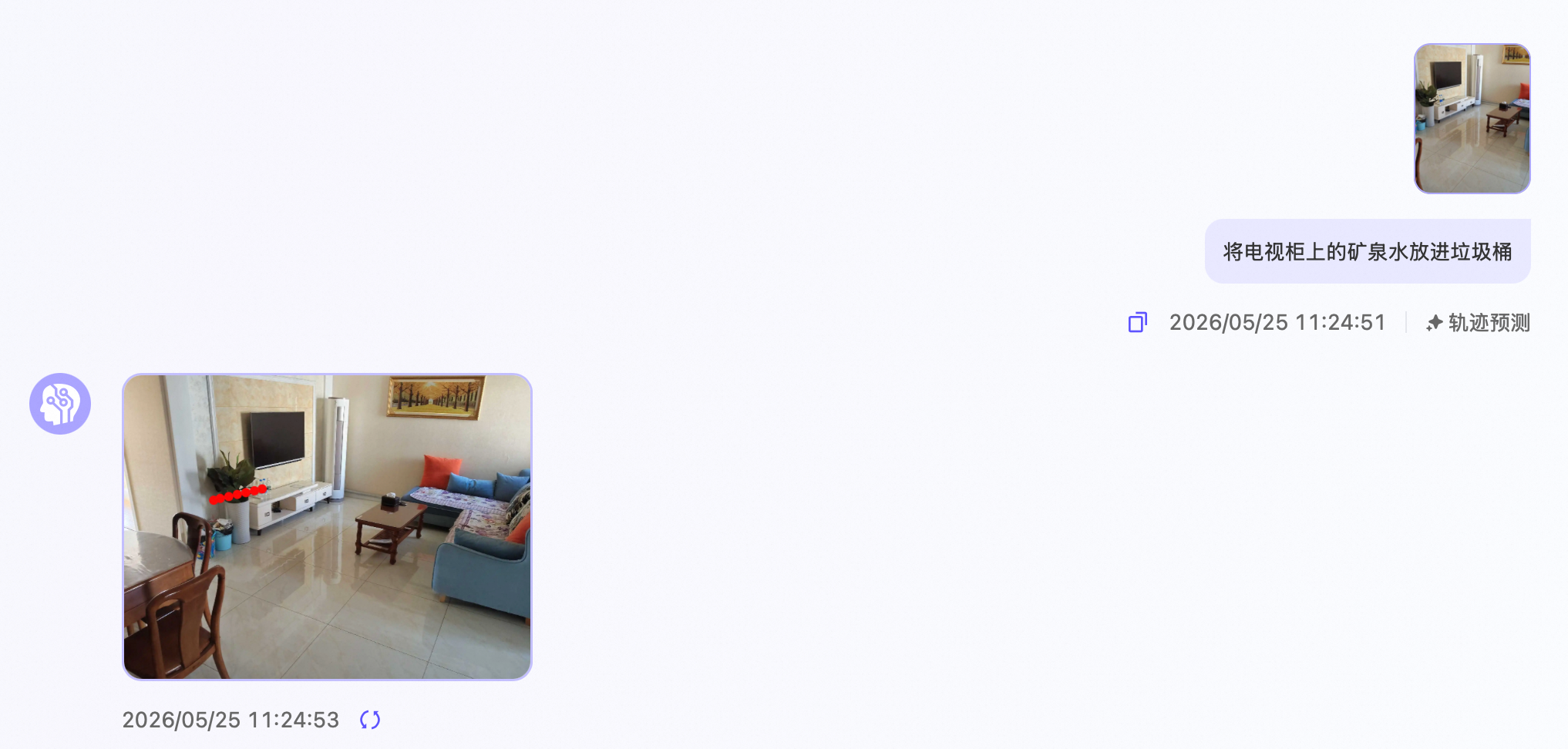 |
Related article: RynnBrian model invocation reference document
7. RynnRCP: Why a protocol layer is still needed
No matter how strong the model is, it cannot automatically solve the fragmentation issues in robot systems. In actual implementation, you still face problems such as inconsistent interfaces among different robots, diverse sensor types, asynchronous control and reasoning chains, and conflicts between on-device real-time performance and cloud computing power. The significance of RynnRCP (Robotics Context Protocol) is to provide an even more engineering-oriented connection mechanism beneath the model.
You can think of RynnRCP as a layer of protocol and tool interface that makes models, sensors, and action modules easier to connect together. It doesn’t compete with the models; instead, it helps the models obtain stable “limbs” and “sensory organs.”
flowchart TD
    A["LLM / VLM / RynnBrain"] --> B["RynnRCP"]
    B --> C["Robot Server"]
    B --> D["Sensor Server"]
    B --> E["Action Server"]
    D --> A
    E --> A
Its significance is not “replacing models,” but rather “enabling models to integrate more smoothly into real robot systems.” This is particularly important for beginners, as many people initially exposed to embodied AI may assume that as long as the model is strong enough, the system will operate naturally. In reality, the protocol layer, interface layer, and system integration layer often determine whether the model can truly be applied in real scenarios.
8. Official Diagram: NVIDIA GR00T
This diagram is more suitable to be understood from the perspective of a “ecological closed loop,” rather than being regarded as a detailed architecture diagram of a single model. The focus of this illustration is not on how the networks are interconnected, but on how NVIDIA organizes basic models, synthetic data, simulation platforms, and robot computing platforms into a unified system:
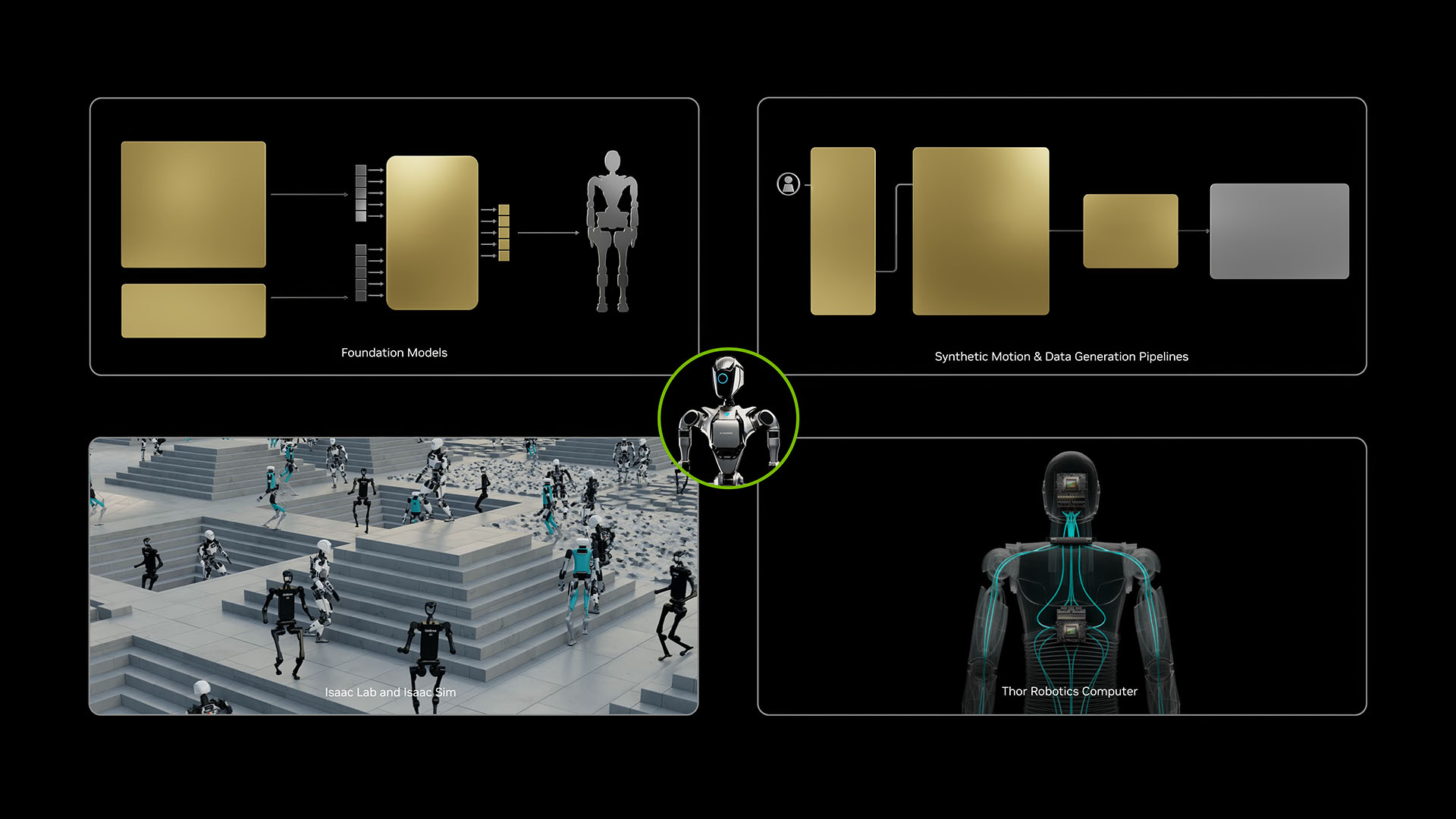
NVIDIA GR00T Official Image
Source: NVIDIA Isaac GR00T official page
The upper left part of the diagram is Foundation Models, indicating that the model itself is one of the core components of this system; the upper right part is Synthetic Motion & Data Generation Pipelines, emphasizing synthesis actions and the generation of synthetic data; the lower left part is Isaac Lab and Isaac Sim, showing that the simulation platform plays an important role in training, validation, and generation; the lower right part is Thor Robotics Computer, corresponding to the on-device computing platform on real robots. The robot image enclosed by a green circle in the middle represents the focal point that connects these four parts: the model is not trained or deployed independently, but integrated into a closed loop of “model-data-simulation-hardware”.
This figure is worth including in textbooks because it reminds learners of a very important point: today’s embodied AI discussions are no longer about individual algorithms, but rather complete technology stacks. Those who can organize models, simulation, data, and hardware more efficiently are more likely to bring systems into reproducible and practical implementation.
9. Summary of this section
If you only need to remember one sentence, remember this one:
VLA is more like “directly mapping what is seen and heard into actions”, while the world model is more like “first predicting how the world will change, and then deciding what actions to take”.
The significant value of systems like RynnBrain lies in bringing stronger understanding, memory, and spatial reasoning capabilities back into embodied AI tasks. They show us that the key competitiveness of embodied AI in the future will not be merely whether it can perform actions, but whether it can first understand the world and then organize its actions steadily and precisely.
10. Daily Tasks
Task 1
Experience the RynnBrain Demo, focusing on:
- Does it only answer questions?
- Does it reflect scene understanding and spatial positioning?
- What is the difference between it and the “action model” you imagined?
Direct link: RynnBrain model experience
Task 2
Write a brief note in any form you prefer. You can use three to five sentences to explain the differences between VLA and the world model, or create a small table to compare what each of Pi0, GR00T, and RynnBrain emphasizes more heavily. The goal here is not to cover everything, but to test whether you have established the judgment that “different model paradigms address issues at different levels”.
11. Further Reading
- VLA model overview: 01VLA related summary and review
- GR00T introduction: Isaac-GR00T README