
Task 04: Summary and Sharing
1. What to do today
On the last day, there won’t be many new concepts added. Instead, the content covered in the previous three days will be reassembled to form a true “conclusion” of learning. Many learners often have a common misconception at the end of a thematic study: it seems they have seen many terms and visited some platform pages, but it’s still difficult to determine what they have actually learned. In reality, the last step in learning is never to add another new concept, but to organize the concepts and experiences that have already appeared into a structured format.
Therefore, today’s task can be summarized into three steps: first, review what insights were gained over these four days; second, determine where to move next if we continue learning; and finally, solidify these understandings into a personal embodied AI application concept. Only by completing this step will the learning in the previous days not remain just “heard about.”
2. Review of the Four-Day Learning Process
By this point, you have actually followed a complete main thread. On the first day, you established the “conceptual framework layer,” meaning you now understand that embodied AI is not just “robots on large models,” but a closed loop system involving the body, intelligent core, and environmental feedback. On the second day, you developed an understanding of the “technical differentiation layers.” You can roughly distinguish between VLA, which emphasizes a unified mapping from perception and language to action; world model, which focuses on predicting and planning environmental changes; and systems like RynnBrain, which emphasize spatial memory, spatial reasoning, and task scheduling. On the third day, you gained an intuitive grasp of the “engineering layer.” You have seen through the LeCloud platform how data is organized, how models are debugged and called, and how skills are executed and reviewed.
Only when these three layers are connected together can a complete introductory closed loop be formed. Many beginners’ problems aren’t due to missing a concept, but rather they only grasp one of the layers: either they know only the industry stories but not the model paradigm; or they only know the model abbreviations but not the system flow; or they only see platform screenshots without understanding the essence of the task. The real value you have learned over these days is precisely connecting these three layers together.
3. Where to continue next
If you feel “a bit understood, but not yet satisfying” at this point, you can continue along three paths. The first path is to fill in the basic knowledge, which is suitable for those who have not yet established a foundation in robotics, control, and spatial description. Such students often encounter difficulties with coordinate systems, kinematics, and control chains when moving forward, so they should prioritize returning to sections such as Overview of Embodied AI and Robotics Basics and Control, Hand-eye Coordination** to complete the underlying logic of embodiment and control.
The second path focuses on model and simulation, suitable for students who are interested in the concepts and wish to further understand VLA, dataset, simulation environment, and training processes. This path aligns more closely with the “connector between research and engineering”. It is recommended to start with VLA-related summary review, LIBERO dataset, and other embodied AI simulation tools and cutting-edge simulations. These materials will help you connect “how to learn models” with “how to verify systems”.
The third path is the real robot and manipulation, suitable for students who want to actually manipulate a robotic arm, development board, and remote operation link. This path offers the most hands-on experience, but it also presents the highest barriers in terms of environment and hardware. Therefore, it is more appropriate as an advanced direction after completing the main topic. The corresponding content can start with LeRobot dual-armed heterogeneous system remote manipulation and RDK-X5 connecting the lrobot robotic arm for remote manipulation .
4. Which future scenarios are most worth paying attention to
There is no standard answer to this question, but it isn’t purely based on imagination. A more reasonable approach is to prioritize scenarios with “strong real-world needs, extensive repetitive labor, and clear environmental constraints.” Since embodied AI is still far from fully mature, the first areas where progress will occur are not the most ideal scenarios, but rather those with clear task boundaries, high labor costs, and significant automation benefits.
From this perspective, industrial manufacturing, logistics and warehousing, home services, and specialized operations remain the most noteworthy areas for continued attention. Assembly, sorting, handling, and quality inspection in industrial manufacturing naturally have high repeatability; picking, transshipment, and shelving in logistics and warehousing have clear efficiency requirements; storage, delivery, cleaning, and ancillary care in home services directly connect to public expectations of “robots entering daily life”; and specialized operations such as inspection, exploration, and replacement in hazardous environments highlight the unique value of embodied AI in high-risk scenarios.
5. Final Output: Application Concept Document
Please submit a “My Embodied AI Application Concept Paper”. This concept paper does not need to be overly elaborate, nor does it need to cover all technical details at once. The key is to clarify the logic. The best approach is not to list a few nouns, but to truly connect the four elements: “scenarios, roles, skills, and value”.
You can start with the scenario, that is, first answer “where it will be used”. This scenario could be a nursing home, a factory line, a kitchen, or a supermarket warehouse—as long as it is a specific space whose boundaries you can clearly define. Next, describe the character, which refers to the final form of the robot the system will adopt: a bipedal humanoid, a wheeled robotic arm, a fixed collaborative robotic arm, or a small inspection drone. The third step involves listing skills—what exactly does the robot need to learn, such as object recognition, multi-step grasping and placement, obstacle avoidance navigation, or performing complex tasks based on language commands. Finally, state the value, i.e., why this solution is worth implementing: to save labor, reduce risks, improve stability, or enhance the service experience.
If these four parts can be naturally matched together, then this concept document possesses a very important quality: it no longer merely “believes that robots are impressive,” but actually considers “what kind of tasks are suitable for which systems to solve.”
6. A brief example
Scenario: Delivering medicine at night in a nursing home Characters: Wheeled mobile chassis + small robotic arm Skills: Identifying medicine boxes, navigation to rooms, identifying targets, completing delivery and recording status Value: Reduces repetitive work for caregivers and improves nighttime service efficiency
7. What should you take with you at least after this topic ends?
If you finish learning these four days, you should at least gain three levels of understanding. The first level is problem awareness—that is, you understand what the fundamental issues of embodied AI are. The second level is technical judgment—that is, you know why VLA and world model are frequently discussed and what problems they address respectively. The third level is engineering intuition—that is, you understand what the basic engineering pathway from data to skills looks like. After acquiring these three levels of understanding, you are no longer in a state of “having only heard a few buzzwords” but have truly entered this field.
8. A easter egg🎁
After completing the course, want to “play with a real robot”? You’re in Nanjing just right!
On March 22, at Nanjing Jianye · International Youth Conference Center, the DAMO Developer Matrix will host a robotic arm real robot experience at the interactive exchange market. Spaces are limited, so first come, first served~
Registration link: https://developer.damo-academy.com/activity/detail/32026031317733911743293071
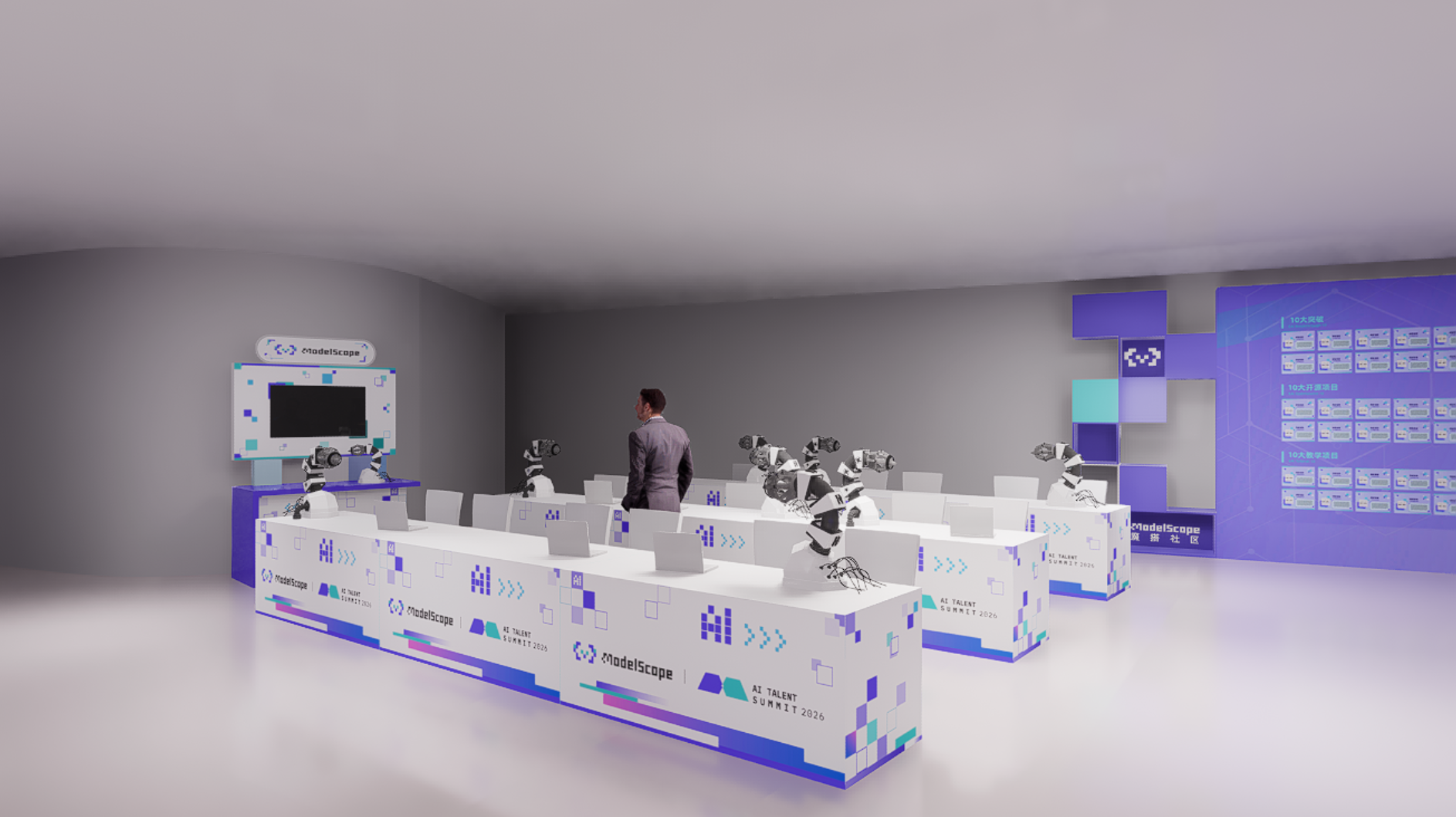
Exhibition area schematic effect (subject to actual situation)